Before, During and After a Remodel
Protecting Viking Appliances From Remodel Dust
Drywall dust finds a condenser faster than anything else on a building site. Viking Appliance Repair Denver — call (720) 770-4189.
Written by Natalia Vukovic
Role Service technician — water systems and leaks · 17 years in the trade
In the trade Finds where the water goes before deciding what is wrong. A seal that shrank at the corner and a fitting that weeps look the same on the floor and cost nothing alike.
A kitchen programme decides very early whether the equipment stays in the room while the building work happens, and that decision is usually made by nobody in particular. It deserves a line on the schedule of its own, because dust is the one site hazard that leaves no mark on the day it lands. Nothing looks damaged. Nothing gets reported. The invoice turns up two winters later, and by then there is no one left to ask.
Where the dust actually goes
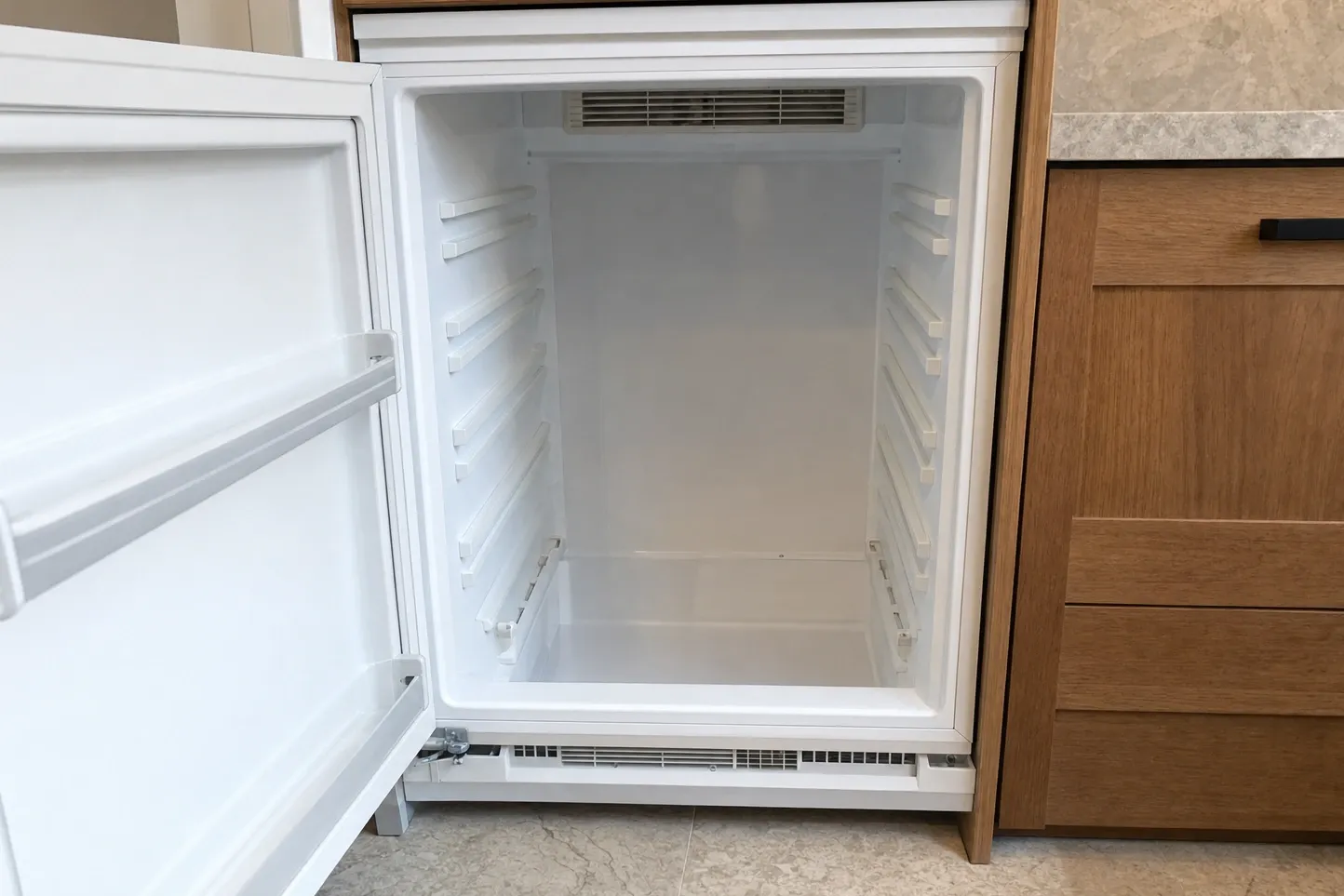
Built-in refrigeration is the part of a kitchen most exposed to a building site, and it is exposed in a way nobody watches. The machine breathes. Room air is drawn through a grille, carried across the condenser and pushed back out low at the kickplate, and fine gypsum sanding dust arrives in that airway at the rate a floor sander produces it rather than the rate a kitchen does.
Viking’s own literature is careful here in a way worth reading twice. The current use and care guide for a 5 Series side-by-side describes a pin-and-tube condenser that resists clogging and calls it maintenance-free under normal operation, and the care chart in the same document says to vacuum the coils when they are dusty or dirty. Both statements are correct. A remodel is not normal operation, so the second one is the sentence that applies to your kitchen this spring.
Everything else in the room has its own openings. The use and care guide for a 5 Series gas range is explicit that the oven vent duct beside the air grille must not be blocked or obstructed, which is easy to forget when temporary sheeting or a new piece of trim ends up across it. A hood’s baffles are built to catch airborne grease and will catch airborne plaster just as willingly. A dishwasher door seal collects grit that then abrades it every single time the door shuts.
Covering without smothering
The instinct is to wrap everything in polythene, and on a refrigerator that is still switched on that is the one genuinely harmful thing available to you. A sealed cover closes the loop the condenser depends on. The compartment holds its temperature for a while, the compressor runs longer and longer to keep it there, and the fault that follows looks nothing whatever like a sheet of plastic. If the unit stays live, the covering stops well short of the grille above and the kickplate below, and somebody puts eyes on it after each trade has been through the room.
Equipment delivered ahead of the cabinetry has an easier answer. The installation guide for a 5 Series built-in tells the fitter to leave the protective film on the stainless until the appliance is in its operating position, which is precisely the right instruction for a unit that will stand in a hallway for three weeks first. Leave the film on. Leave the doors shut. Keep the shipping cardboard underneath it, because protecting the floor is exactly what that guide keeps the cardboard for.
Clean at the close of each phase
Dust is not one substance and it does not all arrive together. Demolition throws coarse debris that settles quickly. Drywall finishing releases the fine fraction that hangs in the air for hours and reaches every opening in the building. Floor sanding gives you both, plus a finish that off-gasses while it cures. Joinery contributes shavings that block nothing and sawdust that blocks everything.
Treating those as four separate events changes the outcome more than the choice of cover does. A wipe-down and a filter check as each phase closes keeps the load off the machinery; one clean at handover only relocates a season of accumulation somewhere less visible. Put the checkpoints on the programme where the trades can read them, and write a name against each one.
Who owns this
The main contractor owns protection for as long as the site is theirs, and that is worth having in writing rather than in conversation. The cabinetmaker owns whatever ends up fitted in front of a vent or a grille. The owner owns the decision about whether the appliances stay in the room at all, and that is the only one of the three that is still cheap to change.
We own what happens after everyone else has gone, which is why the view above is not a neutral one. A condenser cleaned on schedule is a short visit. One that has spent a season insulated under plaster dust, behind a grille held on by screws, is a different appointment altogether — and the space behind that grille is not somewhere an owner should be going with a vacuum attachment.
One term, defined
Condenser fouling
The gradual blanketing of a refrigeration condenser and its airway with fine airborne particles, so the coil sheds less heat into the room, the compressor runs longer for the same cabinet temperature, and the first symptom appears months after the dust did.
Spec check
Confirm each of these before anything is cut, ordered or delivered.
- Whether the appliances stay in the room through demolition and sanding, settled on the programme rather than on the morning it starts
- Which trade is named responsible for covering each unit, and for taking the covering off again
- That nothing draped over a working refrigerator reaches either its top grille or its kickplate
- That the oven vent trim stays clear once temporary sheeting or new joinery goes in front of it
- A wipe-down booked at the close of each dusty phase, not a single clean at handover
Questions on site? Viking Appliance Repair Denver, (720) 770-4189.
Follow-ups we get asked
Is it better to take the appliances out of the house altogether?
Sometimes, and it is a programme question rather than an appliance one. Anything that can be lifted out and stored dry usually should be. A built-in that would need disconnecting, dollying and re-levelling is often safer left in place and properly protected, so long as somebody is named as responsible for the protection.
Can a refrigerator be left running under a dust sheet?
Only if the sheet stops short of the air openings. A built-in pulls room air through the grille above the door and exhausts at the kickplate, so a cover that reaches either one turns the cooling airway into a closed loop. Drape the doors, leave both openings in open air, and check it daily.
How would I know dust had already done damage?
Usually you would not, which is the difficulty. A fouled condenser does not fail, it works harder, and the running time creeps up over a season or two. If the equipment lived through a build unprotected, have it looked at once the kitchen is finished rather than waiting for a symptom to arrive.