Before, During and After a Remodel
Pulling and Re-Setting a Range for a Floor Refinish
A range out for a floor refinish comes back to a floor that moved. Viking Appliance Repair Denver — call (720) 770-4189.
Written by Natalia Vukovic
Role Service technician — water systems and leaks · 17 years in the trade
In the trade Finds where the water goes before deciding what is wrong. A seal that shrank at the corner and a fitting that weeps look the same on the floor and cost nothing alike.
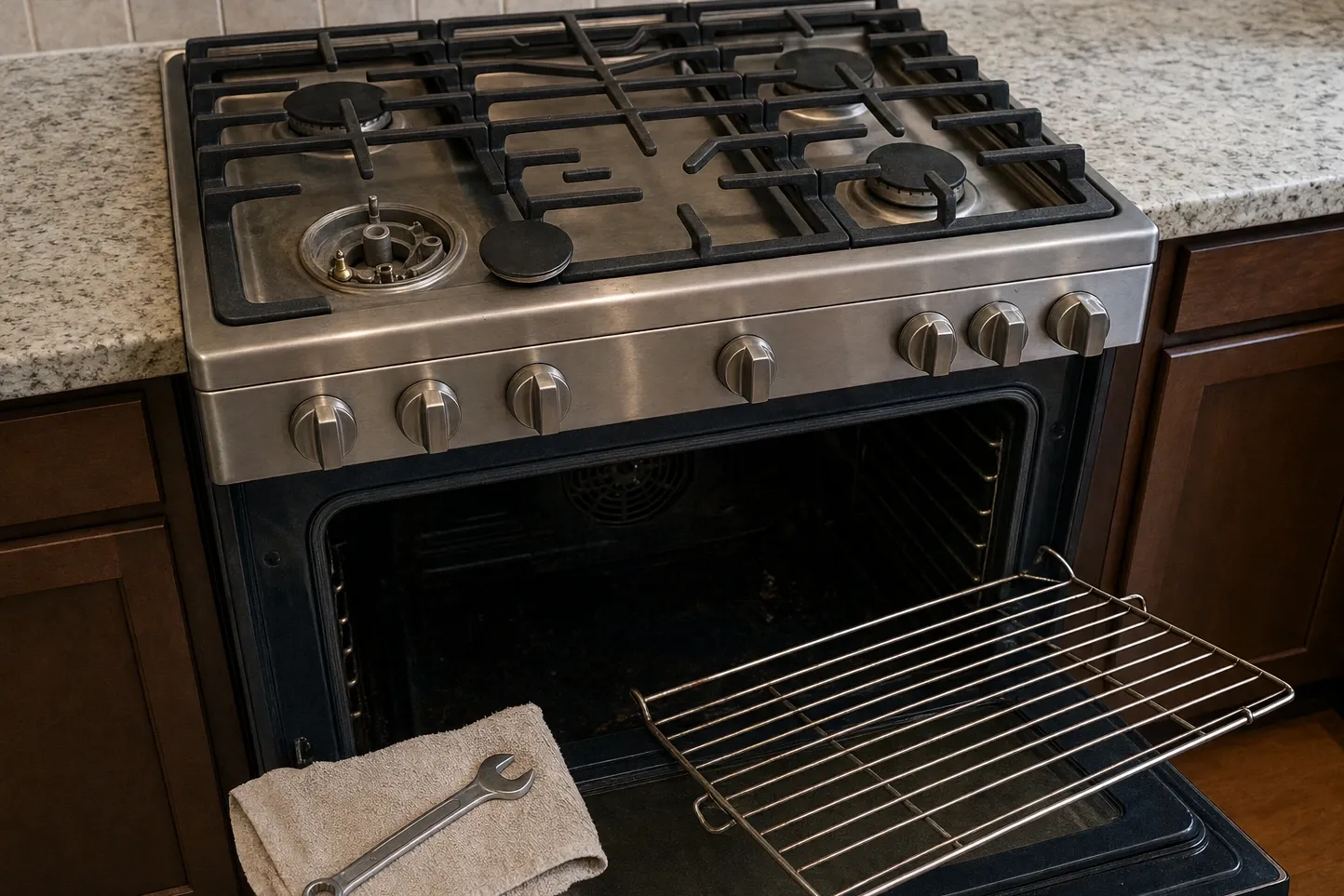
Refinishing a floor under a professional range is a sequencing decision long before it is a physical one. Somebody has to disconnect the appliance, somebody has to move it, somebody has to put it back, and the floor it comes back onto is not the floor it left. Settle the three names and the one dimension at the programme stage and the whole job is uneventful. Leave them and the kitchen gets handed back with a range that sits proud, rocks slightly, and has nothing holding it down.
Disconnection is not a step you carry out
On a gas range this is the part with no shortcut. Separating the appliance from its supply and reconnecting it afterwards is a gas fitter’s work, booked as its own attendance, and it is not something an owner, a joiner or a floor contractor takes on between other tasks. Viking’s own guidance for a 5 Series gas range assumes exactly this division: it tells the owner to have the installer show them where the gas shutoff valve is and how to close it in an emergency. Knowing where the valve sits is the owner’s job. Working on it is not.
Dual fuel and electric ranges shift the trade but not the principle. The supply comes off at the circuit, by an electrician, and goes back on the same way. In both cases the disconnection and the reconnection are two separate visits with a floor contractor’s week in between, so they are booked as two, and the second one is booked before the first one happens.
What changes while it is out
An opening looks unchanged and is not. New boards, a different underlay, a thicker build-up of finish — any of them moves the surface the appliance stands on, and the range was levelled to the old one. The gap under the worktop changes with it. On a slide-in unit the relationship between the appliance edge and the counter is the visible part of the installation, so a few millimetres shows from across the room.
Two other things move quietly. Anything that ran along the floor behind the range — a supply line, a flexible connection, a cable — now lies at a slightly different height and may be under tension it was not under before. And the floor protection that let the appliance be slid out has to be there to slide it back in, which is a conversation with the floor contractor about their cure time, not about our schedule.
Re-setting the legs and the bracket
Levelling is done against the finished floor, not the subfloor, and it is done before the worktop gap is judged rather than after. The appliance carries its weight on all its feet, so a leg left short is not a cosmetic matter — it is a rock that works its way into the door alignment over a year.
The anti-tip device is the part that gets forgotten in almost every floor job, because it was installed once, by somebody else, into a surface that is now in a skip. Viking’s guidance is unambiguous that a range must be secured by a properly installed anti-tip bracket, and it offers a check that needs no tools at all: a flashlight, a look down the back of the appliance, and the bracket plainly holding at the top left rear. Do that one yourself on the day. A range put back without a bracket looks identical to a range put back with one.
Proving it before the trades leave
A range that has been out and back is a range that has been re-installed, and a re-installation is proved the same way a new one is. Light every burner and watch it settle. Run the oven up to a set temperature and let it hold. Open and close each door and look at how it meets the frame. Check that nothing new — trim, a panel, a run of sheeting — has ended up across the oven vent.
Anything that turns up in those ten minutes is somebody’s to fix while they are still in the house. The same fault found in November is a service call, a diagnosis and a conversation about who was responsible in July. That is the entire argument for putting a recommissioning slot on the programme: not that something will go wrong, but that the cost of finding it changes completely the day the last van pulls away.
One term, defined
Anti-tip device
A bracket that secures a range against tipping, taking hold of the appliance once it is pushed home. Viking's guide sends the owner round the back with a flashlight to see it holding at the top left rear, because an installation that looks finished from the front may not be one.
Spec check
Confirm each of these before anything is cut, ordered or delivered.
- Who disconnects and who reconnects the range, named on the programme before the floor contractor is booked
- Whether the new floor finishes higher or lower than the old one under the appliance opening
- That the anti-tip device is re-fixed into the finished floor or the wall, and verified engaged afterwards
- That the shutoff stays reachable with the range pushed home, and the connection long enough to draw it out
- A working test of every burner and the oven booked while the trades are still on site
Questions on site? Viking Appliance Repair Denver, (720) 770-4189.
Follow-ups we get asked
Can the floor crew move the range themselves?
They can move it once it is disconnected, and that is the distinction that matters. Separating a gas appliance from its supply and putting it back is work for a gas fitter, booked as its own visit. Sliding a disconnected range clear of an opening on protection board is ordinary site handling, and most floor crews do it well.
Does a new floor really change anything under a range?
It changes the one dimension everything else was set from. Boards, underlay and a build-up of finish all alter the height the legs stand at, so the worktop gap, the door alignment and the anti-tip engagement are now set against a surface that has moved. None of that is difficult to correct. It is only difficult to notice.
What is worth checking before the contractor leaves?
Run every burner, run the oven up to a set temperature, and open and close the doors. Anything odd is far cheaper to resolve while the trades are still in the house. Viking Appliance Repair Denver takes that call on (720) 770-4189, and a recommissioning visit booked in advance beats one booked in a panic.
