Before, During and After a Remodel
Storing a Built-In Refrigerator for Three Months
Where a built-in spends the remodel decides what state it comes back in. Viking Appliance Repair Denver — call (720) 770-4189.
Written by Natalia Vukovic
Role Service technician — water systems and leaks · 17 years in the trade
In the trade Finds where the water goes before deciding what is wrong. A seal that shrank at the corner and a fitting that weeps look the same on the floor and cost nothing alike.
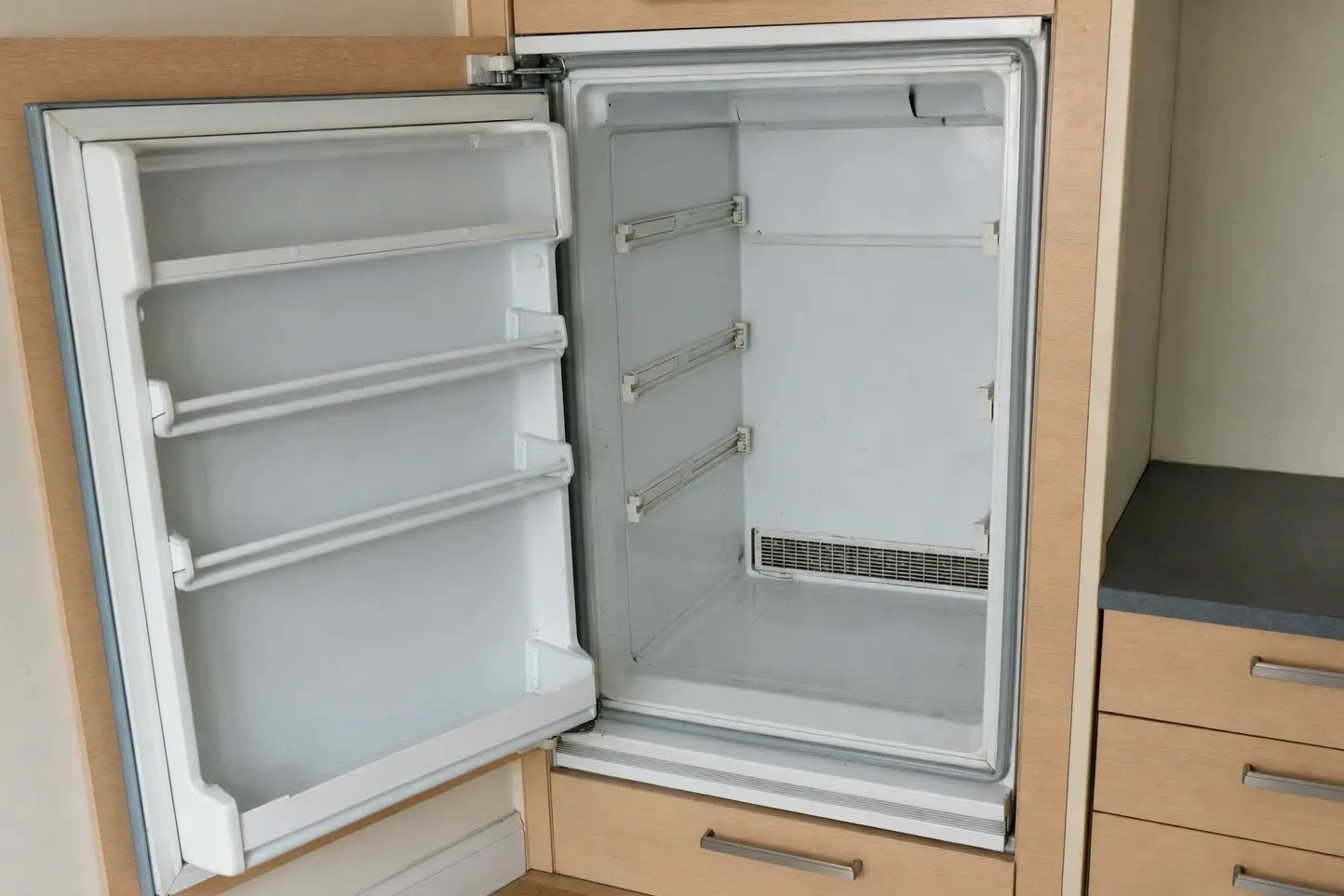
A built-in refrigerator is the only appliance in a kitchen remodel that cannot simply be put somewhere. It is heavy, it is top-heavy, it is worth protecting, and it needs a decision made about it weeks before the demolition date. The decision is not whether to store it. It is where, in what condition, and who handles it at both ends.
Upright, on a dolly, and never by one person
Start with the handling, because that is where the damage that matters usually happens. The installation guide for a 5 Series built-in is direct about it: most of the unit’s weight sits at the top, extra care is needed when moving it to prevent tipping, two or more people are required, and the appliance must not be dropped. It also asks that the doors stay closed until the unit is fully installed and secured, which applies just as much to a unit coming out as to one going in.
The same guide has the fitter slip a dolly between the appliance and its skid and use spare packaging to protect the decorative trim. That is the model to copy on the way out. Leave the protective film on anything that still has it — the guide keeps that film on until the appliance reaches its operating position — and keep cardboard or plywood under the unit rather than dragging it across a finished floor.
Where it should not spend the winter
The obvious answer is the garage, and on the Front Range the garage is usually the worst of the available options. A kitchen appliance is engineered around the temperature range of a kitchen. Compare whatever your model’s own guide says about the conditions it is meant to live in with what an uninsulated Denver garage actually does in January and again in July, and treat the garage as the option of last resort rather than the default.
If a conditioned space exists, the unit goes there. A spare room, a finished basement and a rented climate-controlled unit are all better than the far wall of the garage. Whichever it is, the appliance needs a flat surface where all four legs carry weight, clear of anything that will be moved past it for three months, and out of direct sun through a window.
Doors, seals and what grows
Viking’s guidance for an absence of a month or more is a short list and it is worth following exactly, because every line on it solves a problem that appears later. Remove all the food and the ice. Turn the unit off at its own power disconnect. Clean the interior and the door gaskets. Prop the doors open with rubber or wooden blocks so air can circulate inside, which is what stops odour and mould establishing themselves. Raise the signal arm on the automatic ice maker and close the water supply to it.
Two of those deserve emphasis for a remodel specifically. Propping rather than latching is the difference between a cabinet you can use in April and one that needs stripping and airing first. And closing the water is not only about the ice maker — a supply left live behind a wall that is about to be opened up is a plumbing question as well as an appliance one.
Bringing it back
Reinstallation is not the reverse of removal, it is a fresh installation, and the manufacturer treats it that way. The installation guide ends with a performance checklist, and the items on it are the ones to ask for by name: cabinet size verified, electrical and water supply verified, the anti-tip device installed and the unit confirmed secure, the appliance levelled at the right height in its cutout, operation verified, the ice maker fill tube seated and its bail arm down, the doors aligned and square, the drain pan correctly fitted with no leaks at the water connection, the kickplate on, and the internal packaging and labels removed.
One thing not to guess at: whether the unit should stand for a period before it is switched on after being moved. Some manufacturers specify a wait and some do not, and the answer belongs to the guide for your model rather than to a rule of thumb. Look it up while the appliance is still in storage, so nobody has to decide it on the doorstep with a delivery crew waiting.
One term, defined
Storage position
The state a built-in is left in while it waits out a building programme: standing upright on all four legs, powered down at its own disconnect, emptied and dried, and with its doors held open far enough for the interior air to keep moving.
Spec check
Confirm each of these before anything is cut, ordered or delivered.
- Where the unit will physically stand for the whole programme, and whether that space is heated
- Who lifts it out and who brings it back, with the same crew size the manufacturer asks for
- That the water supply is closed and the ice maker arm raised before the unit is powered down
- That the doors are propped open on something soft rather than latched shut in storage
- Whether the model's own guide asks for any wait between standing the unit up and switching it on
Questions on site? Viking Appliance Repair Denver, (720) 770-4189.
Follow-ups we get asked
Why can a built-in not be laid flat to move it?
Because nothing in the manufacturer's handling instructions contemplates it. Viking's installation guide moves these units standing up, on a dolly, with two or more people, and warns that most of the weight is high and the cabinet tips easily. A unit on its side is outside everything the maker has written down about handling one.
Is an unheated garage acceptable for three months?
It is the default choice and rarely the right one on the Front Range, where a garage swings far outside anything a kitchen appliance was drawn around. Read what your model's guide says about operating conditions, then pick the warmest dry space you have instead. Conditioned storage is cheaper than a sealed-system diagnosis afterwards.
Do the doors have to be left open?
For anything longer than a few weeks, yes. Viking's own long-absence guidance is to empty the unit, power it off, clean the interior and the door gaskets, and prop the doors open with rubber or wooden blocks so air can circulate. A sealed cabinet with residual moisture in it grows odour and mould instead.