Air Out, Air In
How Much Hood a Viking Pro Range Needs
Sizing a hood to a pro range, and why the headline number is the easy part. Viking Appliance Repair Denver — call (720) 770-4189.
Written by Natalia Vukovic
Role Service technician — water systems and leaks · 17 years in the trade
In the trade Finds where the water goes before deciding what is wrong. A seal that shrank at the corner and a fitting that weeps look the same on the floor and cost nothing alike.
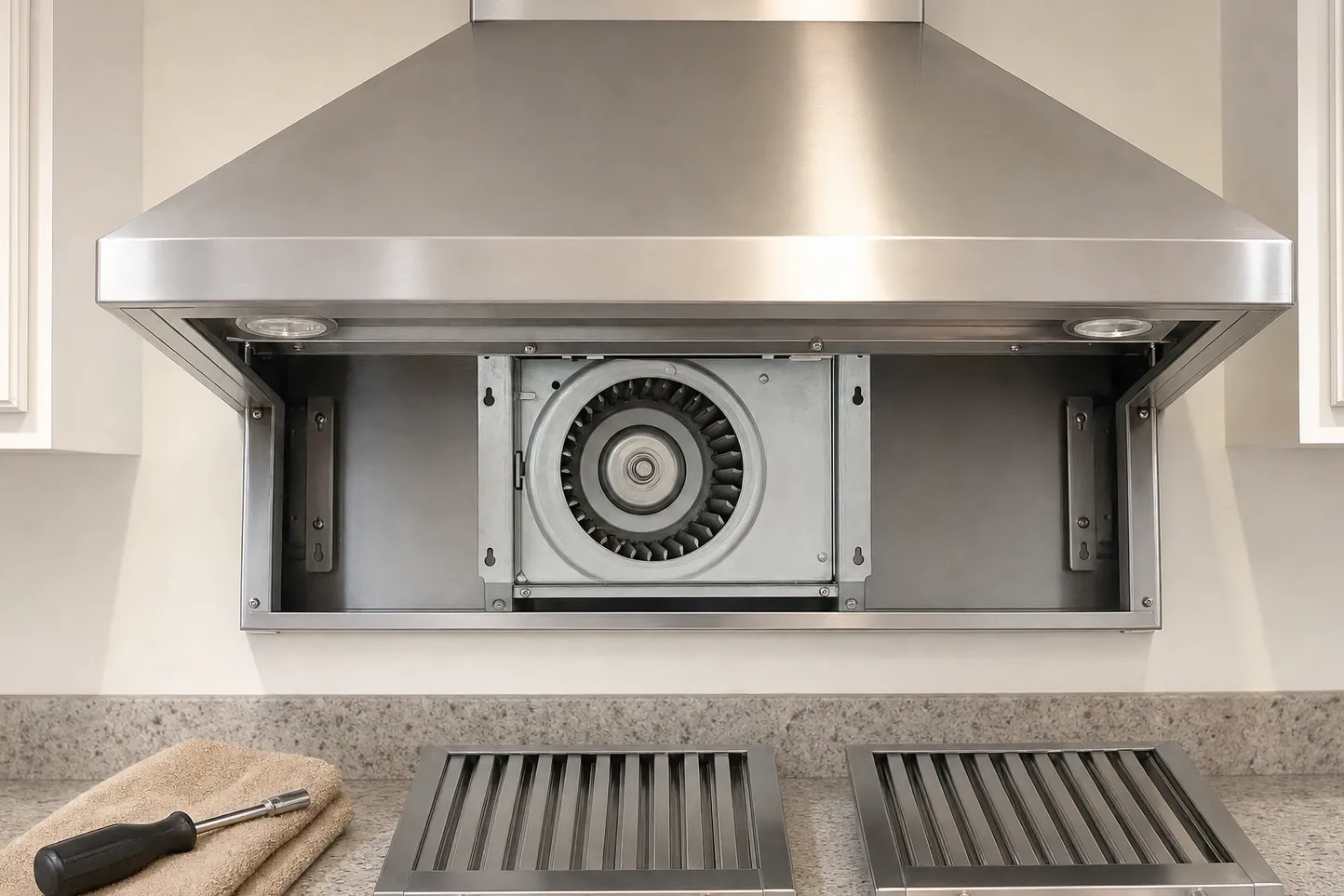
Hood selection usually arrives at the design table as a single number, and the number is the last thing that should be argued about. A canopy is sized against the appliance it hangs over, against the room it hangs in, and against the route the air will take to get outside. Get those three settled and the airflow figure falls out of them. Start with the figure and everything else becomes a negotiation with a decision already made.
What follows is the order the decision holds up in, and where each part of it is written down.
What the hood is being sized against
A professional range puts far more heat into a room than a conventional one, and it does it across a wider cooktop with more burners going at once. That is the load: a hot plume rising off several burners, carrying grease, water vapour and, on a gas appliance, the products of combustion. A canopy exists to catch that plume before it spreads and to move it out of the building.
So the first question is not how much air, it is how much plume, and the honest answer is that it depends on the appliance and on how it gets used. A range whose oven does most of the work and a rangetop under a wok burner are not the same problem. The manufacturer publishes a recommended ventilation figure in the installation instructions for each model, and that document is the starting point for the conversation rather than a brochure line or a showroom recollection.
Width and depth before airflow
Capture is geometry before it is airflow. A plume that has already drifted out from under the edge of the canopy is not going to be pulled back under it by a faster fan, so the canopy needs to cover the cooking surface with something to spare at each end. A hood that finishes flush with the appliance is working at its limit from the first day.
Depth matters at least as much and gets attention half as often. Front burners sit close to the front edge of the cooktop, and a shallow canopy hung over a deep professional appliance leaves the busiest two burners outside the capture area entirely. Measure front to back, not only side to side, and check the number against the canopy depth on the specification sheet.
Both dimensions are cheap to change while the drawing is open and impossible to change once a chimney is built into the ceiling detail around the hood.
The rated number is a ceiling, not a promise
An exhaust rate is measured on a test rig, under a resistance the laboratory controls. Your kitchen is not a test rig. Between the blower and the outside air sits a length of duct, some number of turns, whatever diameter the duct was reduced to where it crossed a joist, and a termination with a damper that has to open. Each of those takes something off the top.
That is why two identical hoods, in two houses on the same street, do not perform the same way. It is also why a hood specified right at the edge of what the appliance wants tends to disappoint: there is nothing in hand to pay for the duct. Treat the rated figure as a ceiling the installation spends down from, and give the design some headroom rather than none.
The duct is a large enough subject to have a page of its own in this series, and it is worth reading before the route is fixed rather than after.
What a bigger number costs you
Airflow is not free in three separate ways. A more powerful blower is louder, and noise is the single most common reason a perfectly functional hood ends up run on its lowest speed for the rest of its life. A more powerful blower wants a larger duct, which needs somewhere to go inside a ceiling that has joists in it. And past a threshold set by the code edition your jurisdiction enforces, a kitchen exhaust has to be given air to replace what it removes, which is a provision with a cost and a location and a control of its own.
None of those is an argument for undersizing. They are an argument for choosing the number deliberately, with the consequences on the same sheet of paper, while a mechanical contractor is still in the room.
Who signs off the final figure
The clean division is worth stating because it saves arguments later. The appliance manufacturer publishes what the range wants. The hood manufacturer publishes what its canopy delivers and at what mounting height. The mechanical contractor owns the duct, its diameter, its route and its termination, and therefore owns the difference between the rated figure and the real one. The authority having jurisdiction owns the make-up air threshold and what counts as compliance with it at this address.
We own none of that, and say so on purpose. What we own is the hood after it is in: blowers, controls, dampers, filters and the diagnosis of a canopy that has never worked properly since the day it was commissioned. That last job is far easier when somebody wrote the four numbers down at the design stage, which is the only reason this page exists.
One term, defined
Exhaust rate
The volume of air a ventilation hood removes from a room in a given time, measured on a test rig under controlled resistance. It describes what the blower can do, not what a particular installation with its own duct, fittings and termination will deliver.
Spec check
Confirm each of these before anything is cut, ordered or delivered.
- The ventilation figure printed in the installation instructions for the exact range model that has been ordered
- The width of the canopy against the width of the appliance, and how much it overhangs at each end
- The canopy depth against the front-to-back position of the front burners
- Whether the exhaust rate you land on crosses the make-up air threshold enforced at this address
- Who is supplying the hood, who is ducting it, and who is signing the final figure off
Questions on site? Viking Appliance Repair Denver, (720) 770-4189.
Follow-ups we get asked
Does a wider hood always work better?
Wider helps at the ends, where a plume drifts out from under a narrow canopy, but width on its own buys very little if the duct behind it is undersized. Treat width and depth as the first decision and airflow as the second, and read both off the instructions for the model being fitted.
Where is the recommended ventilation figure for my range written down?
In the installation instructions published for that exact model number, not in the brochure and not on a retailer listing. Download them from the manufacturer before the hood is ordered. If the number you have came from somebody's memory, it is worth ten minutes to replace it with the printed one.
Can you tell me what size hood to buy?
We repair ventilation rather than specify or install it, so the sizing belongs to your hood supplier and your mechanical contractor. What Viking Appliance Repair Denver can do on (720) 770-4189 is look at an existing hood that underperforms and tell you whether the box or the duct is the reason.