Air Out, Air In
Make-Up Air in a Denver Kitchen Remodel
Past a certain exhaust rate the code stops leaving make-up air to chance. Viking Appliance Repair Denver — call (720) 770-4189.
Written by Natalia Vukovic
Role Service technician — water systems and leaks · 17 years in the trade
In the trade Finds where the water goes before deciding what is wrong. A seal that shrank at the corner and a fitting that weeps look the same on the floor and cost nothing alike.
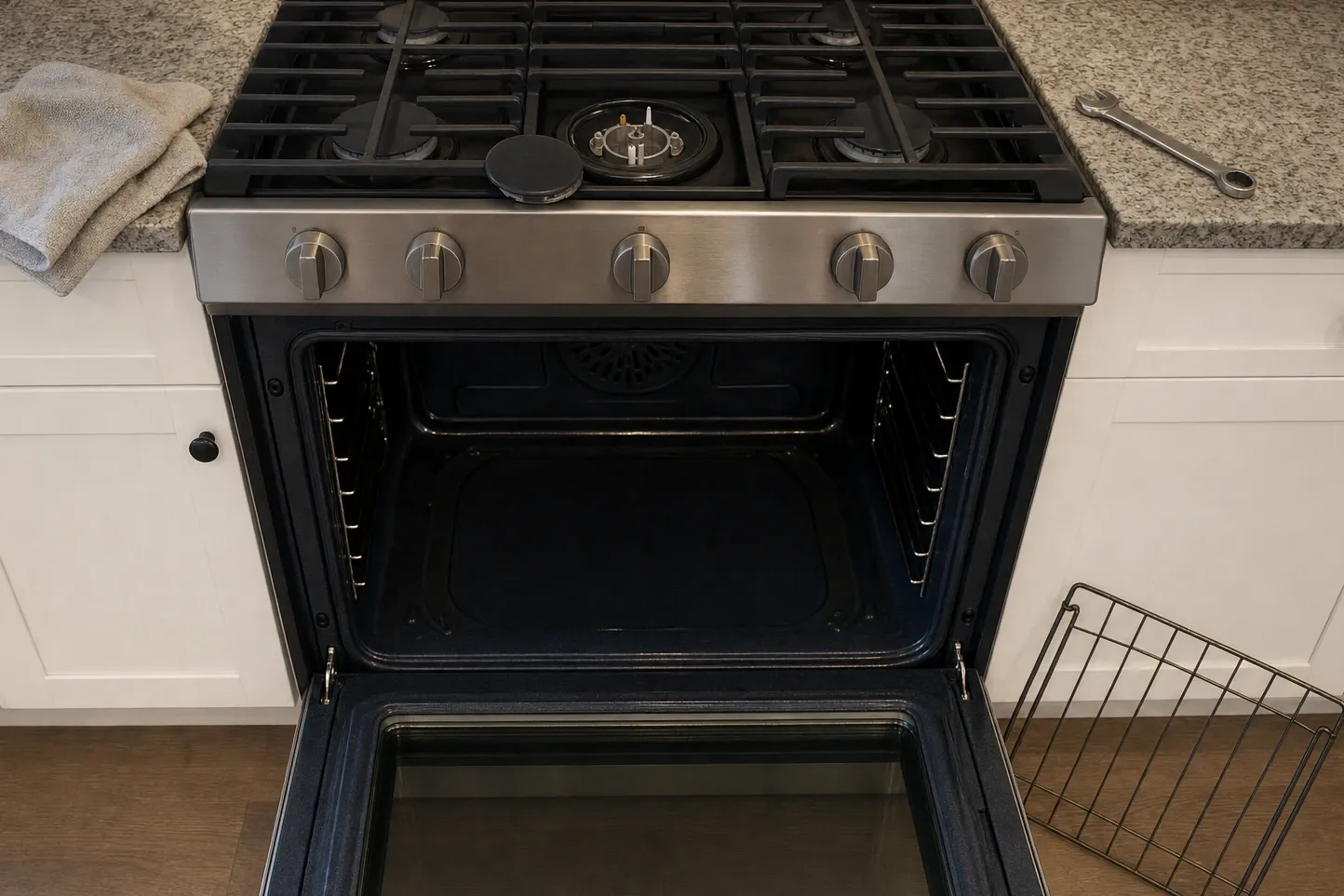
Make-up air is the part of a ventilation design that gets discovered late, and discovering it late is expensive. It arrives as a line in a plan review after the cabinetry has been ordered, or as an inspector’s question on a job that everybody thought was finished. Neither is a nice place to meet it.
The underlying idea takes one paragraph. Everything that makes it complicated is local, and local is exactly the part nobody can answer for you from a website.
What make-up air is for
Run a powerful kitchen exhaust in a reasonably tight house and you are taking air out faster than the building can quietly let it back in. The room does not run out of air; it goes slightly negative, and the house starts looking for replacement air anywhere it can find it. Gaps around doors. The dryer duct. In an older house with an atmospherically vented water heater or furnace, the flue of that appliance, which is a route designed to carry exhaust in precisely the other direction.
That last case is why this stopped being a comfort question and became a building code one. It is also why a make-up air provision is not a fan bolted on as an afterthought: it is a deliberate opening, in a chosen place, with a damper that opens when the hood runs and stays shut when it does not.
The second symptom, and the one homeowners notice first, is that the hood itself stops working. A blower with nothing to pull is just a noise. People assume the appliance is faulty and replace it, and the replacement behaves exactly the same way.
Where the threshold comes from
Model codes set an exhaust rate above which a make-up air provision is required. The rate, the wording and the list of acceptable provisions all come from the particular edition a jurisdiction has adopted, and jurisdictions along the Front Range do not all adopt the same edition in the same year. Denver has its own adoption cycle; so do Lakewood, Boulder, Littleton and every other municipality whose name might be on your building permit.
This page therefore prints no number, and you should treat any page that does print one with suspicion unless it says which edition and which city. The question to ask, in this form, is: for this address, under the code you are enforcing this year, at the exhaust rate we are specifying, is a make-up air provision required, and what will you accept as one?
Ask it of the building department, through your designer or your mechanical contractor, and ask it before the hood is on order. The answer changes the mechanical drawings, sometimes the electrical, and occasionally the elevation of an exterior wall.
What a provision actually looks like
At its simplest it is a duct from outside into the house, with a motorised damper that is interlocked with the hood so that one opens when the other runs. Where it gets interesting in Colorado is temperature. An opening that dumps January air into a kitchen at floor level is a provision that the household will find a way to defeat within a season.
So the practical versions place the inlet where the incoming air mixes before anyone feels it, or temper it, or bring it in through the mechanical system rather than through the kitchen wall. Each of those has a cost, a location requirement and a maintenance consequence, and each belongs to the mechanical contractor rather than to the kitchen designer. What the kitchen designer owns is making sure the question is asked early enough that the answer can still influence where things go.
Who to ask, and when
Sequence is most of the value here. The exhaust rate is chosen when the hood is chosen, which is usually early. The make-up air question follows directly from that number, so it should be asked in the same conversation, not at rough-in and certainly not at final inspection.
A short list of who owns what: the hood supplier owns the rate the appliance will run at. The mechanical contractor owns the duct, the inlet, the damper and the interlock. The building department owns the threshold and what satisfies it. The general contractor owns making sure it is in somebody’s scope rather than in the gap between two of them.
Our own part comes later, and it is narrow on purpose. We repair the hood, not the airway around it. But a hood that was never given air to move is the single most common reason we are called out to ventilation that has behaved badly since the day it went in, and that call is a lot shorter when somebody can tell us what the make-up air provision is and whether it opens.
One term, defined
Make-up air
Outdoor air deliberately brought into a building to replace air that a powered exhaust removes, delivered through a dedicated opening with its own damper and control rather than through whatever gaps the construction happens to leave.
Spec check
Confirm each of these before anything is cut, ordered or delivered.
- The exhaust rate the specified hood will actually be set up to run at, in writing from the supplier
- Which code edition the authority having jurisdiction for this address is enforcing this year
- Whether that edition requires a make-up air provision at the rate you have chosen
- Where the inlet would come into the house, what opens its damper, and whether the incoming air is tempered
- Which trade is carrying the provision in its scope, and whether it appears on the drawings yet
Questions on site? Viking Appliance Repair Denver, (720) 770-4189.
Follow-ups we get asked
What makes make-up air a code question rather than a comfort one?
A house is a closed box. Air pulled out of the kitchen has to be replaced from somewhere, and if no path is provided the building finds one through whatever leaks, including flues that were meant to carry exhaust the other way. Codes set a rate above which a deliberate path is required.
Can I just crack a window when the hood is on?
As a stopgap on a mild day it helps, and on a cold Denver evening nobody does it twice. It is also not a provision in any compliance sense, because nothing guarantees it is open when the hood runs. Ask your mechanical contractor what the adopted edition actually accepts.
Who should I be asking about the threshold for my address?
The building department with jurisdiction over the property, through your contractor or designer. Editions differ between Denver and the surrounding municipalities and they change, so a figure quoted from another project is worth nothing. If a hood already installed is struggling for air, Viking Appliance Repair Denver will look at it on (720) 770-4189.
