Air Out, Air In
Why a Recirculating Hood Is the Wrong Answer Over a Pro Gas Range
A recirculating hood filters grease and returns everything else to the room. Viking Appliance Repair Denver — call (720) 770-4189.
Written by Natalia Vukovic
Role Service technician — water systems and leaks · 17 years in the trade
In the trade Finds where the water goes before deciding what is wrong. A seal that shrank at the corner and a fitting that weeps look the same on the floor and cost nothing alike.
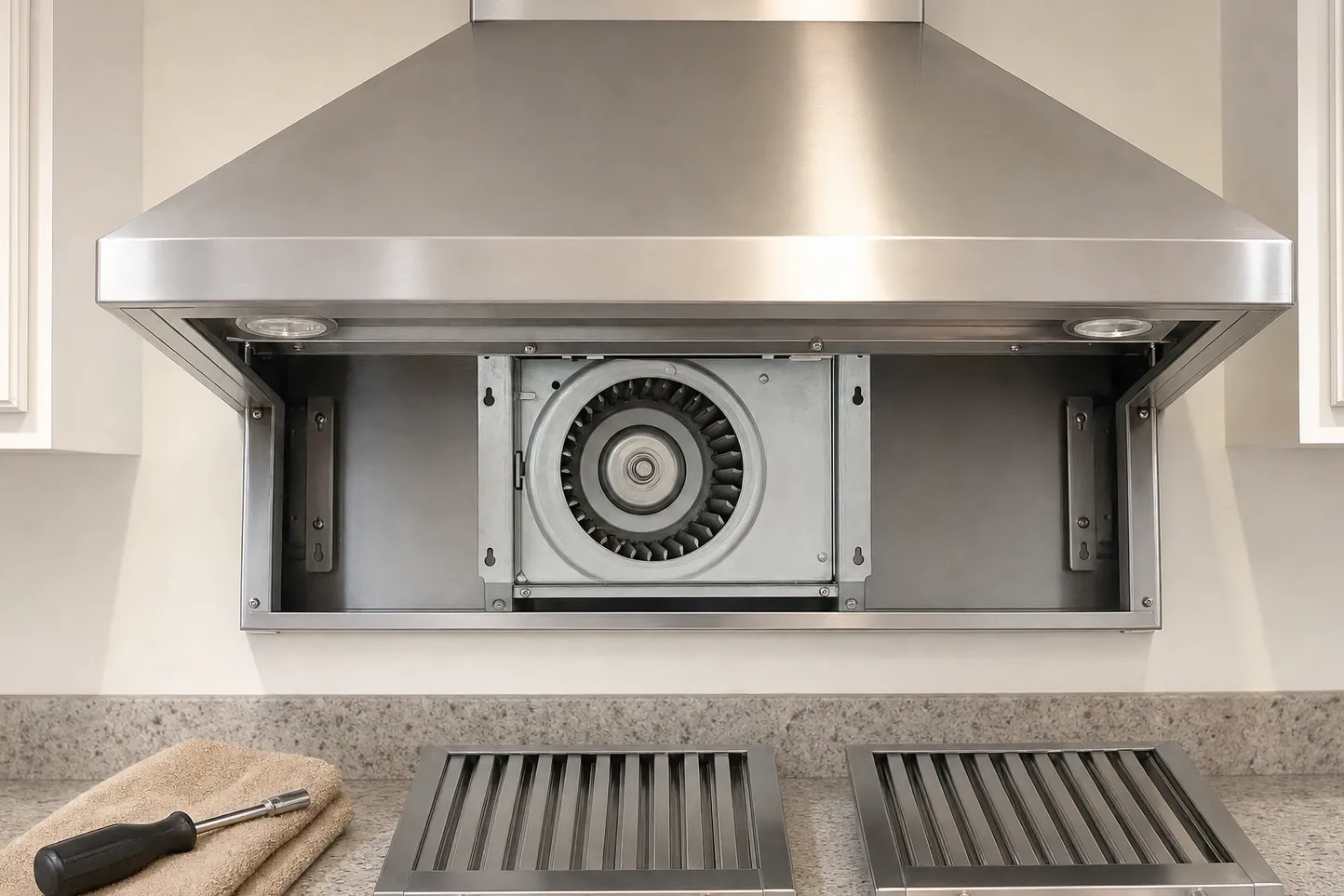
A recirculating hood is a fan, a grease filter and a cartridge of activated charcoal in a box that looks exactly like a ducted one. It is fitted because ducting looked difficult, because a designer liked the shape, or because a specification was written without anybody asking where the air was going to go. Over a conventional cooktop it is a limited but tolerable compromise. Over a professional gas range it is a poor match for what the appliance produces.
This page is about the physics of that, and about what to do if the ductless unit is already in.
What a charcoal filter takes out, and what it leaves
Two filtration stages sit in a recirculating hood and they do different jobs. The metal baffle or mesh filter takes grease out of the airstream mechanically; it is washable, it works, and it is the reason a ductless hood keeps the cabinets cleaner than no hood at all. The charcoal cartridge behind it adsorbs some fraction of the odour compounds that pass through, until its surface is loaded, after which it is a restriction rather than a filter.
What neither stage does is remove water. Boiling, steaming and braising put a great deal of moisture into the air of a kitchen, and a recirculating hood returns every bit of it to the room. In a tight, well-insulated house that moisture has to go somewhere, and it goes into the finishes and onto the cold surfaces.
And neither stage is a gas scrubber. Charcoal is chosen for odour, not for the products of combustion, and it is neither specified nor tested as a device for removing them.
Combustion products stay in the room
This is the part specific to gas, and it is the reason the compromise is worse over a professional range than over a modest one.
A gas burner turns fuel and air into heat, water vapour and the gases of combustion. A ducted hood carries all of that outside, which is most of what a kitchen exhaust is for in a gas kitchen. A recirculating hood catches the grease and hands the rest back. A professional range has more burners, higher outputs and a cook using them harder, so there is simply more of everything to hand back.
Nothing about that is a reason to be frightened of a gas range; it is a reason to duct the hood over one. Where a recirculating unit is what exists, two practical measures follow. Ventilate the room by other means while cooking, which usually means an open window and accepting the heating cost. And make sure the house has working carbon monoxide alarms on every level, tested, with current batteries — advice that is worth following in any house with a fuel-burning appliance and not only this one.
What is emphatically not an owner task is anything involving the burners, the gas connection or a flue. Those belong to us, to the appliance manufacturer’s own documentation, or to a gas fitter.
When recirculation is genuinely the only option
It does happen. A condominium whose governing documents forbid a new penetration of the exterior wall. A landmark facade where the termination cannot be placed. An interior unit with no wall to reach and no chase to rise through. In those buildings the choice is a ductless hood or nothing, and a ductless hood is better than nothing.
What is required in that situation is not an opinion from a website. Whether recirculation is permitted at all over the appliance you are installing depends on the code edition your jurisdiction enforces and on the appliance’s own installation instructions, and both of those are specific to the address. Put the question to the building department through your contractor, in writing, before the hood is ordered.
If recirculation is confirmed as the route, then specify it properly: the correct charcoal cartridge for the model, a replacement interval written into the handover documents, and a note for whoever owns the house next. A loaded cartridge is the most common reason a ductless hood gets quietly worse over a couple of years.
What to do when ducting looks impossible
Before accepting that verdict, have somebody competent look for a route rather than assume there is not one. Exterior walls behind cabinetry, soffits above a run of uppers, an existing chase from an abandoned flue, a short path to a gable — all of these turn up on houses where the first answer was no. In older Denver houses in particular, an unused chimney or a redundant vent stack is often the opening that makes a ducted hood possible.
If a remodel is coming anyway, that is the moment. Retrofitting a duct into an open ceiling is a modest piece of work; retrofitting one into a finished kitchen is a demolition project. The decision is worth revisiting every time the room is opened up, because it is the one ventilation choice that genuinely cannot be improved later without disruption.
We service recirculating hoods the same as any other: the blower, the controls, the lighting, the switch and the fan housing are all repairable. What we cannot do is make one behave like a ducted hood, and it is more useful to say that plainly than to sell a part that will not change anything.
One term, defined
Recirculating hood
A ventilation unit with no duct to the outside. It draws air through a grease filter and usually a charcoal cartridge, then returns that air to the kitchen, so everything the filters do not capture stays inside the building.
Spec check
Confirm each of these before anything is cut, ordered or delivered.
- Whether the hood as specified is ducted to the outdoors or returns its air to the room
- What the jurisdiction for this address requires of ventilation over the appliance being installed
- Whether an exterior route exists through a wall, a soffit or a chase before anyone concludes it does not
- If recirculation is genuinely unavoidable, the charcoal cartridge part number and how often it has to be replaced
- Whether working carbon monoxide alarms are fitted on every level of the house
Questions on site? Viking Appliance Repair Denver, (720) 770-4189.
Follow-ups we get asked
What does a charcoal filter actually remove?
The metal filter catches grease. The charcoal cartridge adsorbs a portion of the odour compounds passing through it, and it does that less and less well as it loads up. Neither element removes water vapour, and neither is a scrubber for the gases a burner produces.
Is a recirculating hood ever acceptable over gas?
It is a compromise people sometimes have no alternative to, in a condominium where no exterior route is permitted, for example. It is never equivalent to a ducted hood, and the appliance and code requirements for the address decide whether it is allowed at all. Ask the building department, not the showroom.
We inherited one. What now?
Establish whether a duct route exists, because retrofitting one during any future work is usually cheaper than living with the alternative. In the meantime open a window while cooking, replace the charcoal on schedule, and keep carbon monoxide alarms tested. Viking Appliance Repair Denver services the hood itself on (720) 770-4189.