Panels, Doors and Reveals
Wall Oven Cutouts and Trim Gaps in a Tall Cabinet
A wall oven cutout is cut once. What it has to be, and who confirms it. Viking Appliance Repair Denver — call (720) 770-4189.
Written by Natalia Vukovic
Role Service technician — water systems and leaks · 17 years in the trade
In the trade Finds where the water goes before deciding what is wrong. A seal that shrank at the corner and a fitting that weeps look the same on the floor and cost nothing alike.
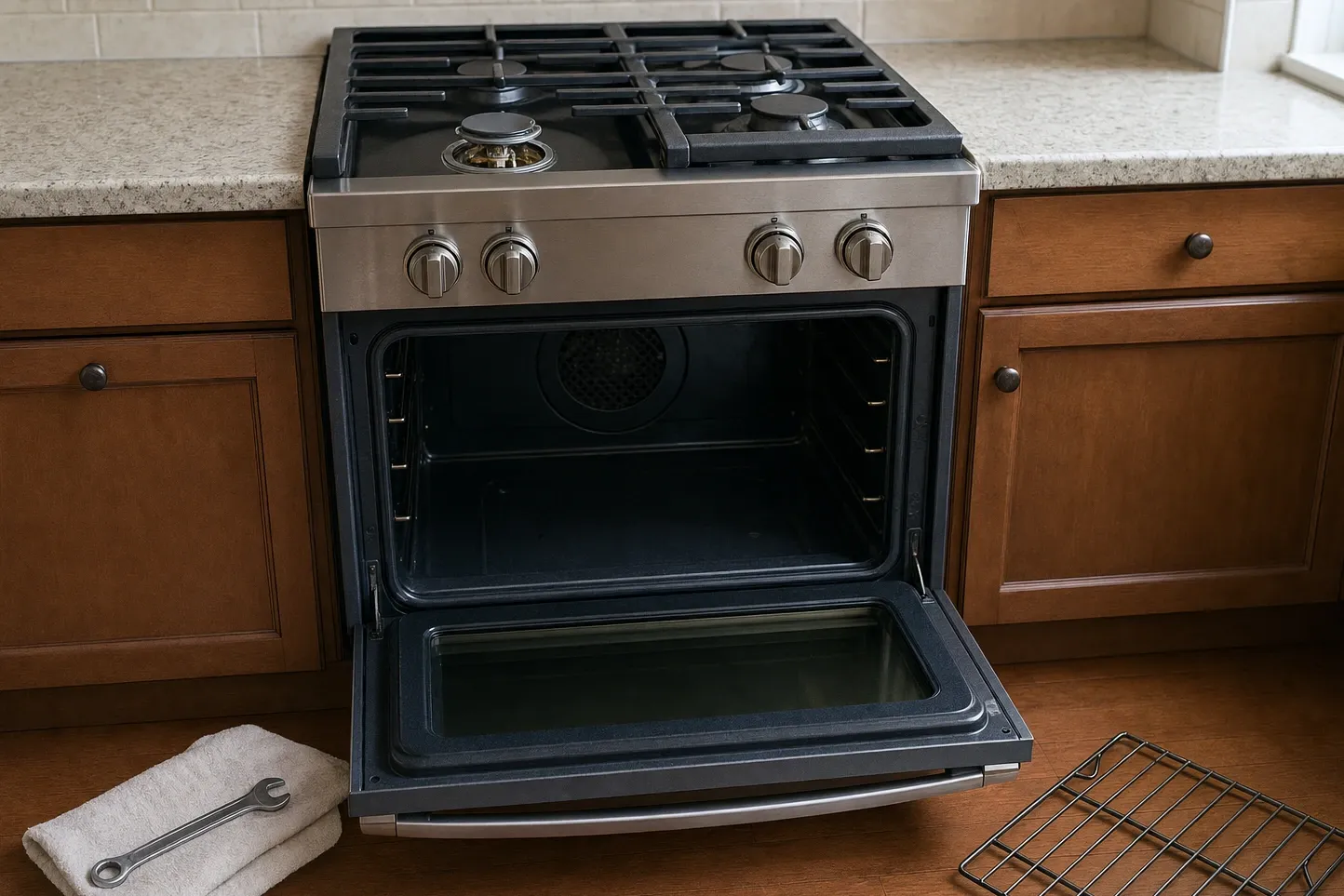
A wall oven cutout is cut once. Everything else in a tall cabinet can be adjusted, packed, scribed or trimmed after the fact, but the hole is either the size the appliance needs or it is not, and a cabinet that was built around the wrong figure is a cabinet that gets rebuilt. This is the page to read before the joiner starts, not after the oven has been delivered.
Rough opening is not the same number as the trim
Two dimensions are published for a built-in oven and they describe different things. One is the rough opening: the hole in the bare cabinet carcass, sized to let the machine in with working tolerance around it. The other is the trim dimension: the outside edge of the finished appliance front, which overlaps the cabinet and hides what is behind it.
The rough opening is always the larger hole and the trim is always the larger face. Confusing the two goes wrong in both directions. A cabinet built to the trim dimension has a hole the oven will not pass through. A cabinet built so the opening matches the trim exactly has nowhere for the front to land, and the appliance sits in a frame with its edges showing.
Take both figures off the installation instructions for the model on the order, label which is which on the joinery drawing, and make sure the person cutting the sheet is reading the same sheet of paper as the person who ordered the appliance.
The gap the trim is there to cover
The trim exists to cover the difference between a hole and a machine, and that difference is intentional. It absorbs the tolerance in the cabinet, the small out-of-square in a tall unit, and the movement in a timber carcass through a Colorado winter of very dry indoor air.
The temptation on a well-built job is to cut the opening tight, because tight looks like craftsmanship. It is the wrong instinct here. A tight opening removes the tolerance the trim was designed to hide, so any movement at all shows as a line of shadow on one side. It also makes the oven difficult to get in, and much worse, difficult to get out.
Where the design wants a very fine finish around the front, that is a conversation about the trim piece and the surrounding cabinetry, not an instruction to shrink the hole.
Getting the unit out again
An oven in a tall cabinet is the hardest appliance in the kitchen to remove, because it weighs a great deal, it sits at chest height, and it has to come straight out onto something before it can be lowered.
Three details on the drawing decide whether that is a straightforward job or a difficult one. The support the oven rests on has to be built to carry it and fixed so that it does not have to be dismantled to release the machine. The services behind the cabinet need enough slack that the unit can be drawn clear of the opening before anything is disconnected. And there has to be somewhere in front of the cabinet to put it — an aisle wide enough to bring a platform in and land the oven on it.
None of that costs anything at the design stage. All of it is expensive to arrange on the morning of a repair, in a finished kitchen, with a stone floor underneath.
Confirming before the cabinet is built
Four confirmations settle a wall oven cabinet and all four happen on paper.
Confirm the model number against the order acknowledgement, not the specification the designer wrote six months earlier, because a substitution during procurement is common and the figures do not carry over. Confirm the rough opening and the trim dimension from that model’s own document. Confirm the height of the support surface and what is carrying it. Confirm that the cabinet is square and that the opening measures the same at the back as at the front, which on a tall unit is worth checking twice.
Then dry-fit before the finish goes on. Sliding the appliance in and out once, while the cabinet can still be eased, is the single cheapest quality check in the whole kitchen — and it is the one step that the pressure of a handover date removes from almost every job we are later called to.
One term, defined
Rough opening
The hole a cabinet presents to an appliance, measured on the bare timber before any trim is applied. It is deliberately larger than the machine, and it is a different figure from the trim dimension the finished front will show.
Spec check
Confirm each of these before anything is cut, ordered or delivered.
- The rough opening height, width and depth published for the exact model ordered
- The trim dimension for the same model, so nobody builds to the wrong one of the two
- The height of the support surface the oven will rest on, and what carries its weight
- That the cabinet is square and the opening is the same width at the back as at the front
- How the oven comes out again, and whether the surrounding trim allows it
Questions on site? Viking Appliance Repair Denver, (720) 770-4189.
Follow-ups we get asked
What is the difference between the rough opening and the trim dimension?
The rough opening is the hole in the bare cabinet. The trim dimension is the outer edge of the finished appliance front that will sit over it. One is what the joiner cuts, the other is what the eye sees, and building to the wrong one leaves either a gap or an oven that will not go in.
Why does the depth of the cutout matter if the front just sits proud?
Because the machine has to sit far enough back for its front to land where the design expects, and its services connect behind it. A shelf left in at the wrong depth stops the oven short, and the trim then stands off the cabinetry by a visible amount.
Does the cabinet need to carry the oven, or does the trim hold it?
The cabinet carries it. The trim covers a gap and fixes the appliance in position; it is not a shelf. The oven sits on a surface built to take its weight, and that surface has to be at the right height and properly supported by the joinery.