Panels, Doors and Reveals
The Grille Is Not Decoration: Airflow Around a Built-In
Box in the grille and the unit works harder for years before it complains. Viking Appliance Repair Denver — call (720) 770-4189.
Written by Natalia Vukovic
Role Service technician — water systems and leaks · 17 years in the trade
In the trade Finds where the water goes before deciding what is wrong. A seal that shrank at the corner and a fitting that weeps look the same on the floor and cost nothing alike.
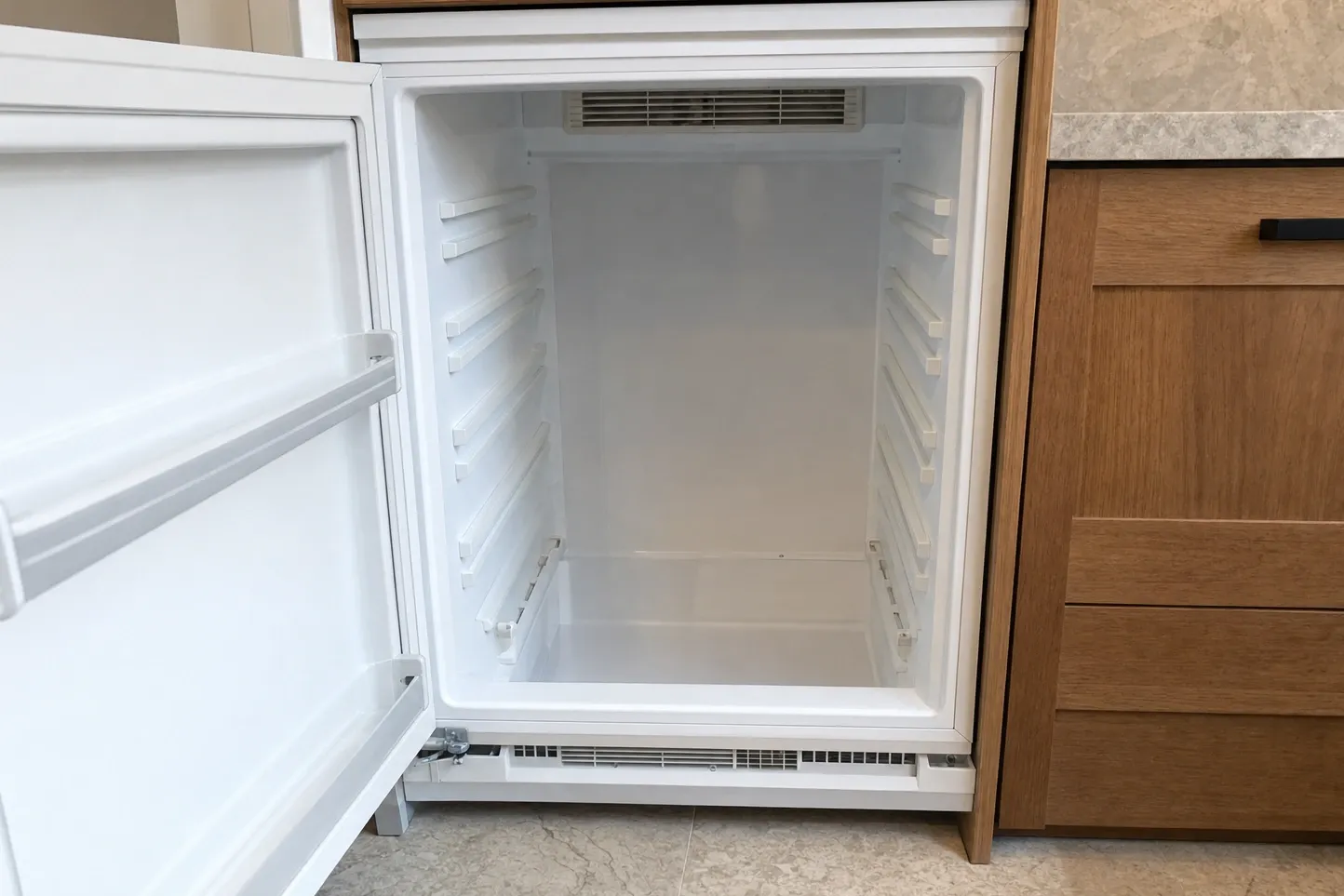
A built-in refrigerator sheds heat. Everything it takes out of the food compartment has to leave the machine somewhere, and on a unit that is sealed into a cabinet on three sides there is only one route out: the grille. That grille is a functional opening with a published size, and in a remodel it is routinely treated as a styling detail to be matched, minimised or covered. The appliance does not complain about this for a long time, which is the problem.
What the grille is actually doing
Behind the grille sits a heat exchanger and a fan. The fan pulls room air across the exchanger, the air picks up the heat, and it leaves. That is the entire mechanism, and it depends on two things: enough air arriving, and the warm air that leaves not immediately being drawn back in.
Which face does what varies by model. Some units take air in low through a kickplate and discharge it high; some work the other way; some divide one tall opening into an intake half and a discharge half. The installation instructions say which, and it is worth reading before anyone draws a cabinet, because an assumption here quietly halves the airway.
An undercounter unit under a run of worktop is the tightest version of this. It has a cavity the size of a cupboard, a grille at one end of it, and often a neighbouring appliance putting its own heat into the same pocket of air.
Three ways a remodel closes it
The first is the matching grille. A joiner is asked to make a timber front that continues the cabinetry, and produces something that looks right and passes very little air, because the slats are deeper and the open proportion between them is lower than the metal item it replaced. The opening is the same size and the free area is not.
The second is trim. A plinth detail, a shadow line, a scribe against the floor or a run of quarter-round goes on last, after the appliance was signed off, and takes a strip off the bottom of the grille. Nobody who fitted it knew what it was for.
The third is enclosure. The unit is boxed in tightly at the sides and the back for a neat carcass, so the air that leaves the discharge has nowhere to go and finds its way round to the intake. The grille is technically clear and the appliance is breathing its own exhaust.
What happens next, and how slowly
Not a failure. That is what makes this hard to diagnose and easy to design in.
A restricted unit simply runs longer. The compressor cycles for more of the day, the cabinet stays within a degree or two of where it should be, and nobody notices anything for a couple of years. The kitchen is warmer near that cabinet and everyone assumes that is normal.
What shortens is service life. Components that were rated for a duty cycle are being asked for more of one, every day, in a warm pocket of trapped air. When something eventually gives, it presents as an ordinary refrigeration fault years after handover, and nothing in the history points back at a grille that was made to match the doors.
The same restriction also shows up in summer. On the hottest week of a Front Range July, a unit with marginal airflow is the one that finally cannot hold temperature, because the room air it is working with started warmer.
What to tell the joiner
Give the joiner the installation instructions and one sentence: this opening is an airway and the number that matters is the free area, not the outside dimensions.
Then check three things on the drawing. That the intake and the discharge are where the document says they are. That nothing fitted after the appliance — plinth, scribe, shadow gap, flooring trim — crosses either of them. And that the grille can be taken off and put back for cleaning without disturbing the run around it, because a grille that nobody can remove is a grille nobody cleans.
If the design genuinely needs a bespoke grille, have it made to the published free area and say so in the joinery specification. It is a cheap line of text and it protects a very expensive appliance from a decision nobody meant to make.
One term, defined
Free area
The part of a grille that air can actually pass through, once the frame, the slats and any decorative mesh are subtracted. A grille and its free area are two different measurements, and only the second one tells you whether the appliance can breathe.
Spec check
Confirm each of these before anything is cut, ordered or delivered.
- Which faces of the unit the installation instructions treat as intake and which as discharge
- That any joiner-made grille matches the published free area, not just the opening size
- That no trim, panel return or plinth crosses the grille after the run is finished
- Where the discharged air goes once it leaves the cabinet, rather than straight back in
- That the grille can be removed for cleaning without the surrounding trim coming off
Questions on site? Viking Appliance Repair Denver, (720) 770-4189.
Follow-ups we get asked
The grille is at the top. Does that mean the appliance breathes upward?
Not necessarily, and it matters. Some units take air in low and discharge it high, some do the reverse, and some use both ends of one opening. The installation instructions for the model say which, and a joiner-made grille placed on the wrong assumption blocks half the airway.
Can a decorative grille be made to match the cabinetry?
Often yes, provided it passes the same amount of air. That is the trap: a timber fretwork can look like the steel grille it replaced and pass a fraction of the air, because the slats are deeper and the open proportion is lower. Match the free area, not the appearance.
What should I look for if the unit already seems to run constantly?
Check that the grille is clear and not covered by a tray or a trim strip, and that nothing is stacked tight against the unit. Beyond that it needs somebody with the panel off. Viking Appliance Repair Denver takes that kind of call on (720) 770-4189.