Panels, Doors and Reveals
Fitting a Custom Panel and Toe Kick to a Viking Dishwasher
Panel, toe kick and spring tension: the three that have to agree. Viking Appliance Repair Denver — call (720) 770-4189.
Written by Natalia Vukovic
Role Service technician — water systems and leaks · 17 years in the trade
In the trade Finds where the water goes before deciding what is wrong. A seal that shrank at the corner and a fitting that weeps look the same on the floor and cost nothing alike.
A panelled dishwasher looks like one piece of cabinetry and is actually three separate things that have to agree with each other: the door front, the toe kick below it, and the tension in the mechanism that decides how the door behaves when somebody opens it. Get two of the three right and the kitchen still does not work properly, which is why this is worth twenty minutes at the drawing stage.
Three separate pieces, one front
The door front is the visible part and the part everyone discusses. It is made to the size, thickness and weight the installation instructions publish for the machine, it is fixed to the door through a mounting arrangement on the back, and it has to be flat, because a dishwasher door seals against a tub and a bowed front will try to twist it.
The toe kick is the piece below, and it is the one that catches people out. On many jobs it is not supplied with the appliance at all: the joiner makes it, in the same material as the run, to a height that depends on the finished floor and on where the machine’s feet have ended up. It is not decorative. It is the access panel for everything underneath.
The third piece has no appearance at all, which is why it gets left out of the drawing. It is the balance in the door mechanism, and it is the difference between a door that stays where it is put and a door that drops open onto somebody’s foot.
Spring tension follows the weight of the door
Every dishwasher door is counterbalanced, so that a flat, heavy slab pivoting at floor level does not simply fall. The counterbalance is set for a door of a particular mass, and a custom timber front can be several times the weight of the plain one the machine left the factory with.
Two things go wrong when the balance is not reset. A door that is too heavy for its setting drops the last part of its travel instead of lowering, which is hard on the mechanism and harder on the person loading it. A door that is too light — rarer, but it happens with a thin front — will not stay down, and creeps back up while the lower basket is out.
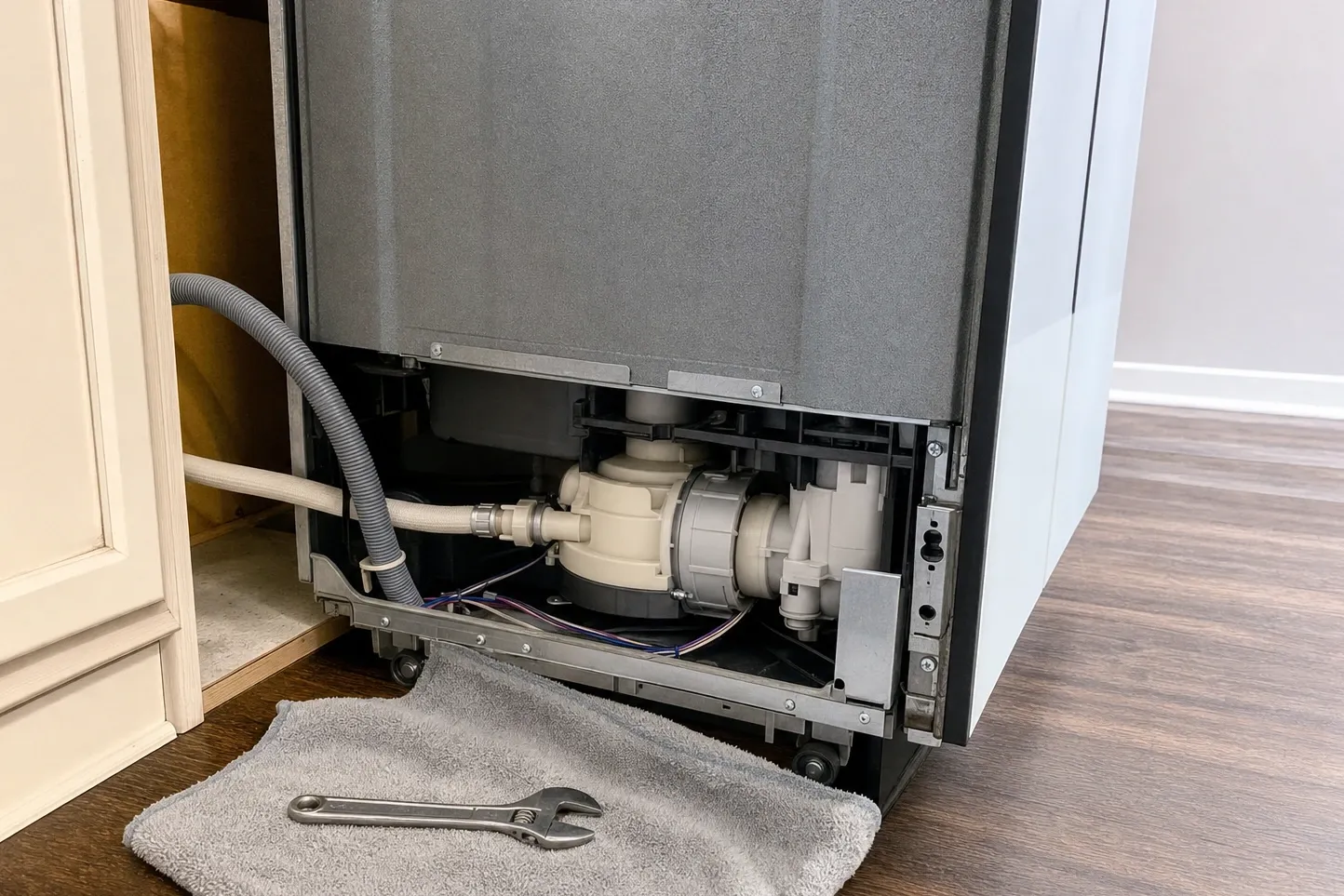
The adjustment is made at the machine, usually with it drawn out and partly opened up, and it is set once the finished front is actually hanging on the door rather than estimated from the joiner’s quote. It is not an owner task and it is not a screwdriver-through-the-gap task. Book it as part of the install and it takes minutes.
The toe kick and the levelling feet argue
A dishwasher is levelled on adjustable feet so that its door lines up with the run and its tub drains as designed. Those feet set the height of the machine above the floor, and the toe kick has to close the resulting gap without touching them.
Where the finished floor stops at the front of the opening, there is a step under the machine, and levelling it means winding the front feet up to meet a floor level that the back feet never see. The toe kick then has to cover a gap that is taller at the front than anyone drew. Ask the floor layer to run the finish under the appliance footprint, or at minimum to keep the substrate level across it.
And fit the toe kick so it comes off. Pinned, magnetted or screwed is fine; glued, scribed into the flooring or trapped behind a later run of quarter-round is not. Every future visit to that machine starts by taking it off.
What the joiner needs in writing
Hand the joiner four things and this stops being an issue: the installation instructions for the model, the finished floor build-up including any underlay, the reveal the designer wants around the front, and a note that the toe kick is a removable piece rather than a fixed one.
Then hand the installer one thing — the actual finished front, hung, before the balance is set. Most of the panelled dishwasher trouble we see in Denver kitchens is not a fault in the machine at all. It is a door that was counterbalanced for a front nobody had made yet.
One term, defined
Toe kick
The recessed board that closes the gap between the base of a cabinet run and the floor. On a panelled dishwasher it is a separate piece from the door front, it is often made by the joiner rather than supplied with the appliance, and it has to clear the machine's levelling feet.
Spec check
Confirm each of these before anything is cut, ordered or delivered.
- The panel size, thickness and weight the installation instructions publish for this dishwasher
- Whether the toe kick is supplied with the appliance or is the joiner's piece to make
- The finished floor height under the machine, and whether it continues beneath it
- That the door spring or cable tension is set for the finished front once it is hung
- How the machine comes out for service without the toe kick or the flooring being cut
Questions on site? Viking Appliance Repair Denver, (720) 770-4189.
Follow-ups we get asked
Why does the door fall open after a custom panel is fitted?
The door is counterbalanced for a certain weight, and adding a heavy timber front changes that balance. The tension on the mechanism has to be reset to match the finished door. It is an adjustment made with the machine partly dismantled, so it belongs to whoever installs or services it.
Should the flooring run underneath the dishwasher?
It is worth asking the floor layer to carry the finish under the machine, or at least to the back of its footprint. Where the floor stops at the face of the opening, the appliance sits on a step, and getting it out later means fighting a lip that was never meant to be structural.
Can the toe kick be glued or pinned in place?
It should not be. The toe kick is the only access to the levelling feet and to the space below the machine, and a fixed one turns a short visit into a joinery job. Fit it so it can be removed. Viking Appliance Repair Denver is on (720) 770-4189 if yours cannot.