Planning Around the Range
Viking 5 Series vs 7 Series: A Side-by-Side for Owners
The Viking 7 Series adds 23,000 BTU front burners and two fridge compressors; the 5 Series offers more sizes. Viking Appliance Repair Denver, (720) 770-4189.
Written by Natalia Vukovic
Role Service technician — water systems and leaks · 17 years in the trade
In the trade Finds where the water goes before deciding what is wrong. A seal that shrank at the corner and a fitting that weeps look the same on the floor and cost nothing alike.
The short answer: the Viking 7 Series is the higher-output line, with 23,000 BTU burners across the front of the cooktop and, in built-in refrigeration, two compressors so each compartment cools on its own. The 5 Series is the broader line, with 15,000 BTU sealed burners, far more widths and fuel types, and a single variable-speed compressor in its built-in refrigerators. Both are serious professional-style equipment. Which one suits you depends on how hard you cook, how wide your opening is, and how much hardware you are happy to maintain in a mile-high kitchen where every gas flame already gives up some of its rated output.
Two lines with very different scope
The 5 Series is the family Viking builds in the most shapes. Its freestanding ranges come in widths from 30 to 60 inches and in almost every fuel arrangement: sealed-burner gas (VGR), open-burner gas (VGIC), dual fuel (VDR), electric (VER) and induction (VIR). The 7 Series is a tighter collection. Viking lists it at 36 and 48 inches only, either as gas (VGR7362, VGR7482) or dual fuel (VDR7362, VDR7482).
That gap is worth settling before anything else. Plenty of owners start by comparing burner numbers and only later realise the cutout in their cabinetry rules one family out entirely. If you want induction, an all-electric range, or a 30-inch or 60-inch width, the 7 Series is off the table. Measure the opening, check whether you have a gas line or only a 240-volt circuit, and then compare.
Burners: sealed 15,000 BTU against Elevation Burners
Every sealed burner on a 5 Series gas range is rated 15,000 BTU on natural gas and 12,500 BTU on LP. On select models the front-right position becomes a TruPower Plus burner, rated 18,500 BTU on natural gas or 16,600 BTU on LP, which gives you one hotter spot for a wok, a hard sear or a big pot of stock.
The 7 Series is laid out differently. Its Elevation Burners place 23,000 BTU burners along the whole front row in each width, several 15,000 BTU burners behind them, and one 8,000 BTU burner at the rear for melting and holding. The ports stand above the cooktop, so a pot that foams over drains underneath instead of crusting onto the burner head. For someone cooking at high heat most evenings, that easier cleanup matters nearly as much as the extra power.
Put simply, the 5 Series gives you evenly matched burners with an optional power position. The 7 Series gives you a row of strong burners in front and a gentle one in back, so the cooktop itself sorts pans by heat.
A word on altitude
Every BTU figure here is a rating at standard conditions. At roughly 5,280 feet the air is thinner, a gas flame delivers less than its label says, and a range installed in Denver should be set up for the elevation. That applies to both lines equally, so it does not tilt the comparison, but a 23,000 BTU burner in a Washington Park kitchen will not quite match the same burner at sea level.
Inside the oven
On 5 Series gas ranges the oven runs on one 30,000 BTU bake burner bent into a U shape, paired with a Gourmet-Glo infrared broiler. SureSpark ignition lights both, and the cavity has six rack positions. Viking’s own advice is that its gas ovens shine at broiling and single-rack baking, while its electric ovens, with Vari-Speed Dual Flow convection, do the better job when you load several racks of cookies or pastry at once. That is the honest case for dual fuel, whether a 5 Series VDR or a 7 Series VDR7362 or VDR7482: open flame on top, convection electric below.
If you are pairing a rangetop with wall ovens instead, both the 5 and 7 Series electric wall ovens run a self-clean cycle of about 3 1/2 hours, then keep the door latched for another 30 minutes while they cool down. Two exceptions catch people out: the French Door single oven (VSOF7301) and the upper cavity of the VDOF7301 double oven have no self-clean cycle at all, so those get cleaned by hand.
Refrigerators: one compressor or two
The split between the lines is clearest in built-in refrigeration. A 5 Series built-in runs one variable-speed compressor with Viking’s ProChill system. A 7 Series built-in uses two, so the fresh-food section and the freezer each get their own cooling and never have to share. Viking says both hold within 1° of the set temperature, so the second compressor is about independence rather than precision: humidity and odors stay apart, and trouble on one side does not normally shut down the other.
The cost of that independence is more machinery. Two compressors mean two sealed systems and more parts to check when a temperature starts to wander. For a household that mostly wants steady cold and a working ice maker, the single-compressor 5 Series is a sensible pick. For a kitchen built around a big freezer, or one that keeps a lot of fresh produce, the dual system earns its keep.
Where the 3 Series fits
Owners weighing the 3 Series against the 5 Series are nearly always working with a 30-inch space, because that is the only width the 3 Series is made in. It comes as gas (RVGR3302), dual fuel (RVDR3302), electric (RVER3301) and induction (RVIR330). Since the 5 Series also builds 30-inch ranges, a narrow kitchen, such as a compact Capitol Hill condo, has two lines to choose from at the same size. Compare the burner ratings and oven features above model by model rather than assuming the higher number wins. Viking’s Tuscany line, offered as dual fuel in TVDR361, TVDR481 and TVDR661 versions, is a further option at the larger widths.
Service, parts and what repairs cost
Neither line is free of upkeep, and the parts that wear are much the same in both: igniters and burner assemblies, oven elements and thermostats, control boards, and in refrigerators the fans and defrost components. A range with more high-output burners carries more ignition hardware, and a dual-compressor refrigerator carries more cooling hardware, so the 7 Series simply has more to look after over its life.
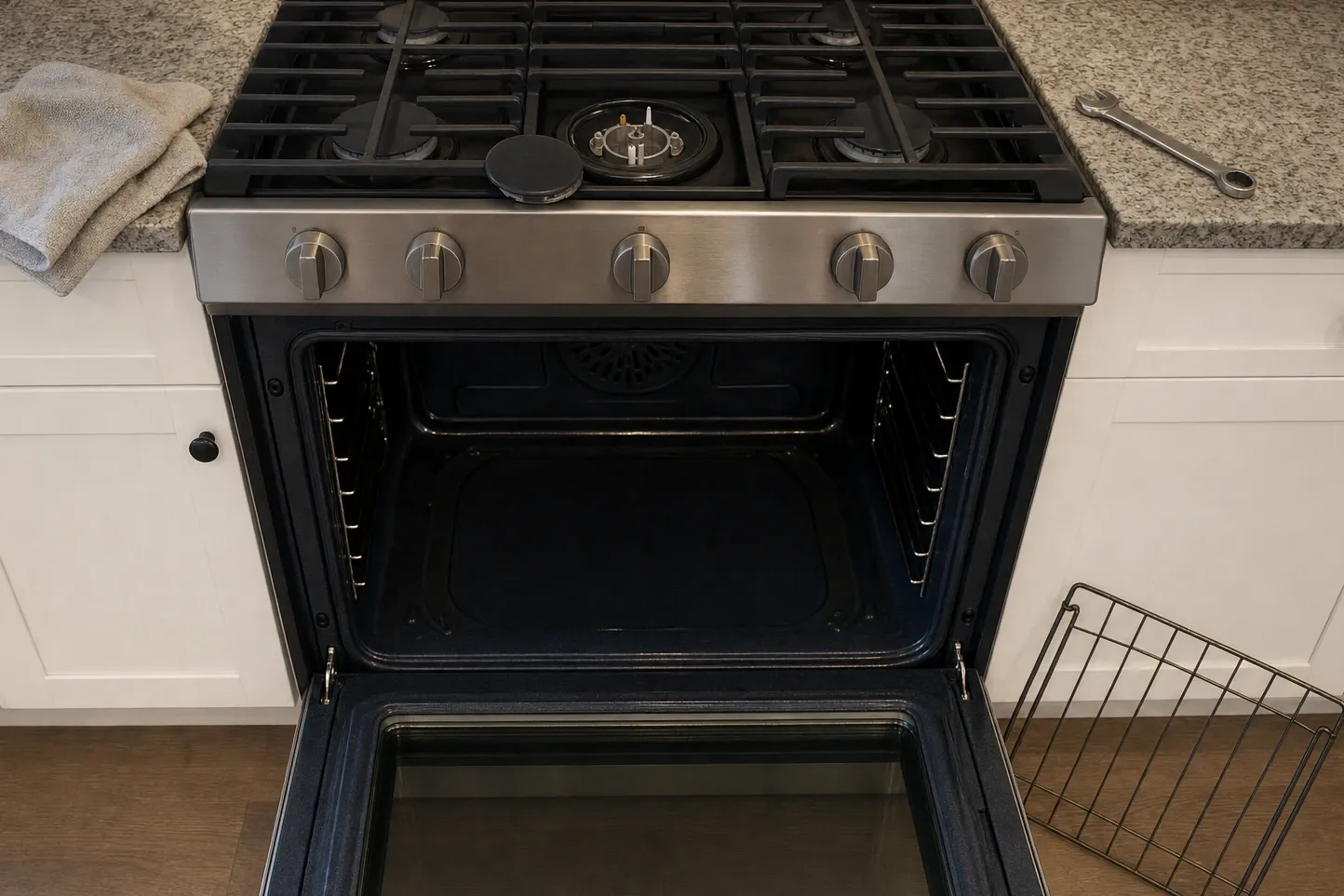
Have the model and serial number ready before you call. On a 5 Series freestanding gas range the rating plate sits in one of three places: on the left side panel under the left-front grate support or burner bowl, on the oven face frame below the control panel, or under the control panel above the door. On a 7 Series range, open the oven door and look beneath the control panel. On a 5 Series built-in refrigerator, check the upper interior wall behind the light.
Typical price ranges for common repairs, with the firm figure given once the fault is found:
| Repair | Typical range |
|---|---|
| Igniter or burner assembly | $180–$460 |
| Oven heating element or thermostat | $210–$470 |
| Refrigeration fan or defrost system | $290–$610 |
| Control board or touch panel | $440–$660 |
| Compressor or sealed-system repair | $1,510–$2,970 |
You pay $89 for us to come out and pin down the fault, and that amount is deducted if the repair goes ahead. We cover Cherry Creek, Washington Park, Highland and Capitol Hill, and the full list sits on our Denver service areas page. Call (720) 770-4189 to set up a visit.
Choosing between them
Lean toward the 7 Series if you cook at high heat most nights, have a 36- or 48-inch opening with gas service, and like spills that wipe away instead of burning on. Lean toward the 5 Series if you need a width or fuel the 7 Series does not offer, want induction or all-electric cooking, or prefer matched burners with one power position. In refrigeration, two compressors buy separation between compartments and one buys simplicity. Either way, choose the line that fits the room and the way you cook, not the one with the biggest figure on the spec sheet.
One term, defined
Elevation Burners
The 7 Series burner design from Viking, with raised ports so a boil-over runs underneath instead of baking onto the burner, and 23,000 BTU burners across the front row.
Spec check
Confirm each of these before anything is cut, ordered or delivered.
- Measure the opening: the 3 Series is 30 inches only, the 7 Series 36 or 48 inches, the 5 Series 30 to 60 inches
- Confirm the fuel at the wall: gas line, LP, or a 240-volt circuit for electric and induction
- Compare burner ratings on the same fuel, since LP figures run lower than natural gas
- Note the model and serial number from the rating plate before ordering parts or booking service
Questions on site? Viking Appliance Repair Denver, (720) 770-4189.
Follow-ups we get asked
Is the Viking 7 Series worth it over the 5 Series?
It is worth it if you want 23,000 BTU burners along the entire front row and raised ports that keep spills from cooking onto the burners. If you need a 30-inch or 60-inch width, induction or an all-electric range, the 5 Series is the line that offers those choices.
What is the difference between the Viking 3 Series and 5 Series?
The 3 Series is built in a 30-inch width only, while the 5 Series spans 30 to 60 inches with more burner and fuel arrangements. Both come in gas, dual fuel, electric and induction at 30 inches, so in a small kitchen the decision rests on features rather than size.
Why is my Viking range igniter not clicking?
A silent igniter usually means the spark circuit has lost power or a part in it has worn out, such as the switch behind the knob or the spark module. Check the breaker and make sure the burner cap is seated properly, then call if it stays quiet. Igniter or burner assembly work typically runs $180–$460, priced firmly after diagnosis.
Do Viking 7 Series refrigerators hold temperature better than the 5 Series?
No, Viking rates both lines to stay within 1° of the set temperature. What the 7 Series adds is a second compressor, so the fresh-food and freezer compartments each cool on their own instead of sharing one system.
Where is the model number on a Viking 7 Series range?
Swing the oven door down and check just beneath the control panel for the rating label that lists the model and serial numbers. A 7 Series rangetop carries its label under the control panel too, and reading it off before you call makes parts lookup much quicker.
