Air Out, Air In
Hood Mounting Height Over a Viking Range
Every hood has a published mounting range. Both ends of it are a choice. Viking Appliance Repair Denver — call (720) 770-4189.
Written by Natalia Vukovic
Role Service technician — water systems and leaks · 17 years in the trade
In the trade Finds where the water goes before deciding what is wrong. A seal that shrank at the corner and a fitting that weeps look the same on the floor and cost nothing alike.
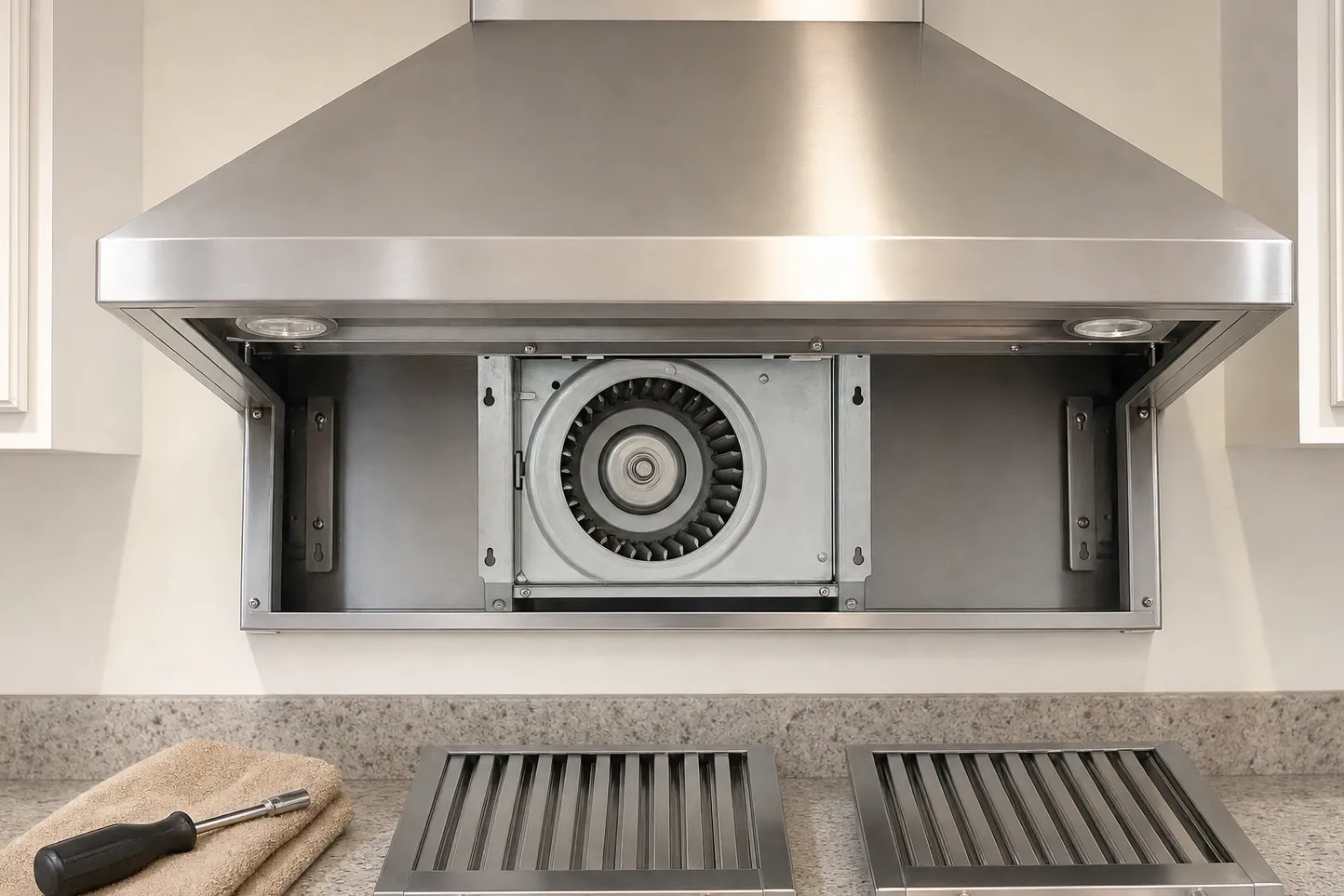
Mounting height is the cheapest ventilation decision in a kitchen and the one most often made by accident. A carpenter puts blocking in the wall at whatever height looks reasonable, the hood goes on it months later, and nobody compares the result with the figure printed in the box the hood arrived in.
The figure exists. It is model-specific, it is a span rather than a point, and choosing inside that span is a real design decision with consequences that turn up every time somebody sears something.
Why there is a range and not a number
Manufacturers publish a permitted span because the correct height is not a property of the hood alone. It depends on the ceiling, the appliance below, the depth of the canopy and the people using the kitchen. Testing establishes the limits within which the unit behaves as designed; inside those limits, the choice is handed to whoever fits it.
That span lives in the installation instructions for the exact model. Not the series, not the finish, not a similar hood from the same maker — the model. It is printed there precisely because it is not the same for every canopy, and a number carried over from a previous project is the most common way a kitchen ends up with a hood in the wrong place.
Two things are worth measuring before anyone commits: the finished height of the cooking surface, taken after the floor covering is down and the appliance is levelled, and the ceiling height at the wall where the hood lands. Both change during construction and both are assumed far too early.
Low captures, high clears the head
At the bottom of the span, the canopy is close to the pans. The plume has the least distance in which to spread, capture is at its best, and the hood is at its most effective on the lowest fan speed, which is also its quietest. The cost is intrusion: the front lip is in the eyeline, tall pots need care, and the tallest person in the household learns where that edge is the hard way.
At the top of the span, the kitchen looks better and nobody bumps anything. The plume has more room to spread sideways before it reaches the canopy, so more of it escapes, and the household compensates by running the hood faster and living with the noise.
Neither end is wrong. What is wrong is picking one without knowing that the trade exists. A useful way to decide is to stand the tallest regular cook at the appliance position, mock the underside of the canopy up with a board, and look at it. Ten minutes on site beats an argument after the tiling.
Above the published range is out of position
There is a failure mode worth naming because it is so frequently misdiagnosed. A hood hung above its permitted span does not underperform in the way a small hood underperforms. It is simply not where the design assumed it would be, and the capture area no longer covers the plume. Grease appears on the cabinet sides. Steam reaches the ceiling. The household turns the speed up, gets noise instead of results, and eventually concludes the hood is faulty.
The tell is that it has been like that since the day it went in. A hood that worked for years and then declined has a mechanical fault or a duct problem. A hood that has never satisfied anybody has a geometry problem, and height is the first thing to measure.
The other half of that check is depth. A canopy hung at the correct height but too shallow for a deep professional appliance leaves the front burners outside the capture area, and the symptoms look identical.
Where the figure is written
Three documents, in this order. The hood’s installation instructions give the permitted span and the clearance requirements at the sides. The appliance’s installation instructions give any clearance above the cooking surface that the range itself imposes, which can be more restrictive than the hood’s. The cabinetry drawings show where the blocking was placed, which determines what is physically achievable without opening a wall.
Read them together before the wall is closed. Blocking is free at framing stage and a small demolition job afterwards, and the difference between a hood that works and one that annoys people for years is often a short length of timber fixed while somebody still had the drawings open.
When a hood is already hung and something is wrong with it, we measure the height against the published span before touching the blower, because the cheapest repair is the one where the appliance turns out to be fine.
One term, defined
Mounting height
The vertical distance from the cooking surface to the underside of a ventilation hood, published as a permitted span in the hood's own installation instructions and chosen within that span by whoever sets the height of the wall blocking.
Spec check
Confirm each of these before anything is cut, ordered or delivered.
- The permitted mounting span printed in the installation instructions for the exact hood model
- The finished height of the cooking surface, measured after the flooring and the appliance legs are set
- The height of the tallest person who will cook there, taken seriously rather than politely
- Where the wall blocking or the ceiling anchor has to sit to allow the chosen height
- Whether the chimney or flue cover supplied with the hood covers the gap at that height and this ceiling
Questions on site? Viking Appliance Repair Denver, (720) 770-4189.
Follow-ups we get asked
Why do the instructions give a span instead of a single height?
Because the right answer depends on the room and the cook. Lower captures more and intrudes more; higher clears heads and catches less. The manufacturer tests within a span and leaves the choice inside it to the person fitting it, which makes the choice yours rather than automatic.
What happens if a hood is hung above the published span?
It is not underpowered, it is out of position, and no fan speed compensates for that. The plume has room to spread before it reaches the canopy, so grease and moisture end up on the cabinets either side. If a hood has never worked well, the height is worth measuring first.
Who should set the height on site?
Whoever installs the hood, working from the instructions and the finished floor level, with the blocking placed by the carpenter beforehand. If a hood in your kitchen is already hung and performing badly, Viking Appliance Repair Denver will measure it against the published span on (720) 770-4189.