Denver Water and the Wet Appliances
High Loop or Air Gap: Dishwasher Drains in a Denver Remodel
Two ways to stop a drain backing up, and who decides which you get. Viking Appliance Repair Denver — call (720) 770-4189.
Written by Natalia Vukovic
Role Service technician — water systems and leaks · 17 years in the trade
In the trade Finds where the water goes before deciding what is wrong. A seal that shrank at the corner and a fitting that weeps look the same on the floor and cost nothing alike.
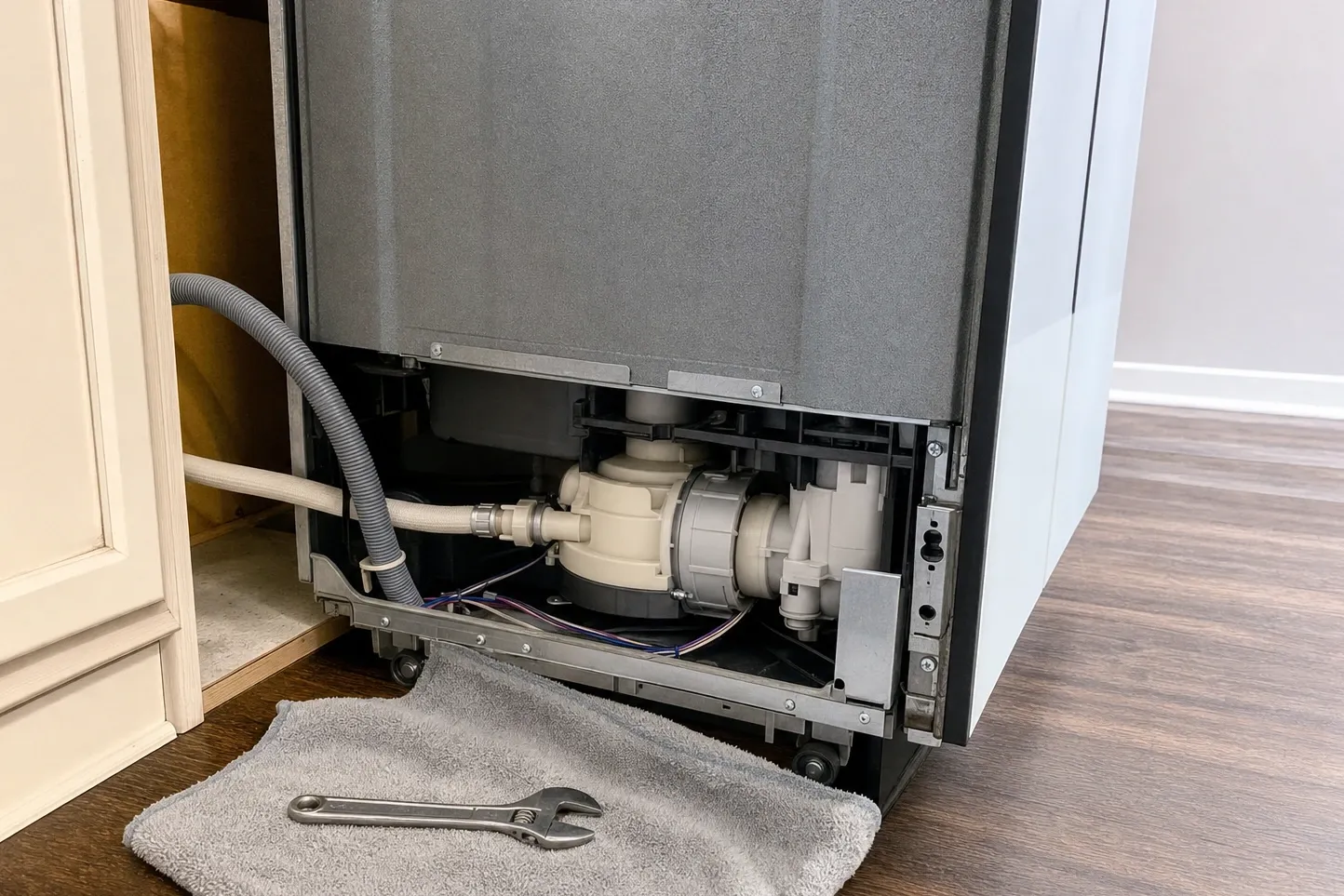
The dishwasher drain is the least glamorous item on a kitchen drawing and one of the few that a building inspector will look at. It also has two accepted answers rather than one, they look completely different on a finished worktop, and the choice has to be made before stone is templated. That makes it a design decision with a deadline, not a plumbing afterthought.
What both arrangements are for
Both exist to stop one thing: water travelling backward from the sink waste into the appliance. A dishwasher empties into the same waste as the sink, so if that waste blocks or the sink fills, there is a path for dirty water to find its way into the machine that has just finished cleaning the dishes.
An air gap breaks the line open to atmosphere. The drain hose rises to a fitting on the worktop, the flow is interrupted in open air inside that fitting, and a second hose carries it down to the waste. Nothing can be drawn backward across a break in the pipe.
A high loop uses height instead. The hose is fastened up under the worktop so its highest point sits above the flood level of the appliance, then falls to the waste connection. Water will not climb over the loop.
How each one is installed, and what it costs the drawing
The differences that matter to a designer are above the counter, not below it.
An air gap is a visible component. It needs a hole in the worktop or the sink deck, it has a finish that has to be chosen alongside the tap and the soap dispenser, and the hole has to be on the fabricator’s template. That last point is the one that goes wrong: the decision surfaces after the stone is cut, and retro-drilling an installed worktop is a specialist operation nobody budgeted.
A high loop is invisible. It is a bracket and a cable tie under the counter, it adds nothing to the worktop, and it costs nothing at all. Its weakness is that it depends entirely on someone actually fastening the hose up there. A loop that was described in a specification and never fixed simply is not a loop — the hose ends up lying across the cabinet base, and the arrangement provides nothing.
Which one your jurisdiction expects
This is where a general article has to stop being general. Plumbing codes are adopted locally, editions differ, and amendments differ again, so what is accepted in one part of this metro is not automatically accepted in the next municipality along. Some jurisdictions require the air gap fitting outright; others accept a correctly fixed high loop.
Ask the building department or the inspector for the address, in writing, before the worktop goes to template. It is one email at the start of a project and it is an expensive conversation to have at inspection.
The signs it was skipped
A drain arrangement that was never really installed gives itself away in the same few ways, and all of them are worth checking at handover rather than months later.
Standing water in the bottom of the cabinet at the end of a cycle. A drain smell that returns a day after the filter is cleaned, because waste air has a path back into a machine that should be sealed against it. Cloudy residue on the load with no other explanation. Or, on a brand-new installation, a machine that will not empty at all — which is very often a new disposer whose dishwasher knockout plug was never removed rather than anything to do with the loop.
Who owns this
The plumber owns the connection and the fall. The worktop fabricator owns the hole, if there is one. The appliance installer owns the hose routing and the fixing under the counter. The kitchen designer owns the only decision that has a deadline attached: which arrangement this kitchen is getting, taken early enough that the template still has time to change.
One term, defined
High loop
A drain hose fastened up under the worktop before it turns down to the waste connection, so the top of the loop sits above the flood level of the appliance. The height is what stops sink water travelling backward into the machine.
Spec check
Confirm each of these before anything is cut, ordered or delivered.
- Which arrangement the authority having jurisdiction expects at this address, confirmed before the worktop is templated
- Whether a worktop penetration is needed for an air gap fitting, and that the fabricator has been told
- That the drain hose is fastened up under the counter rather than resting on the cabinet base
- Where the hose connects on the waste side, and whether the knockout in a new disposer has been removed
- That the drain arrangement is inspected before the toe kick and end panels go on
Questions on site? Viking Appliance Repair Denver, (720) 770-4189.
Follow-ups we get asked
What is the difference between an air gap and a high loop?
An air gap is a fitting on the worktop that breaks the drain line open to atmosphere, so nothing can siphon back. A high loop achieves something similar by height alone, fastening the hose up under the counter. One is a visible component; the other is a fixing detail.
Which one does Denver require?
That depends on the adopted plumbing code and the jurisdiction the address falls under, and editions differ across the metro. It is not a question to answer from a general article. Ask the building department or the inspector covering the address, and get the answer before the worktop is templated.
Does an air gap have to go through the countertop?
The usual fitting mounts in a hole in the worktop or in the sink deck, which means the fabricator needs to know at templating rather than after the stone arrives. Retro-drilling a finished worktop is possible, but it is a specialist job on an installed surface.
Why does a new disposer matter to the dishwasher?
Disposers ship with the dishwasher inlet closed by a knockout plug. If the drain hose is connected without that plug being removed, the machine cannot empty at all. It is a five-minute step at installation and a frequent cause of a brand-new kitchen not working.