Before, During and After a Remodel
Buying a Denver House With Viking Appliances: What to Look At
What to look at, and photograph, before you own somebody else's kitchen. Viking Appliance Repair Denver — call (720) 770-4189.
Written by Natalia Vukovic
Role Service technician — water systems and leaks · 17 years in the trade
In the trade Finds where the water goes before deciding what is wrong. A seal that shrank at the corner and a fitting that weeps look the same on the floor and cost nothing alike.
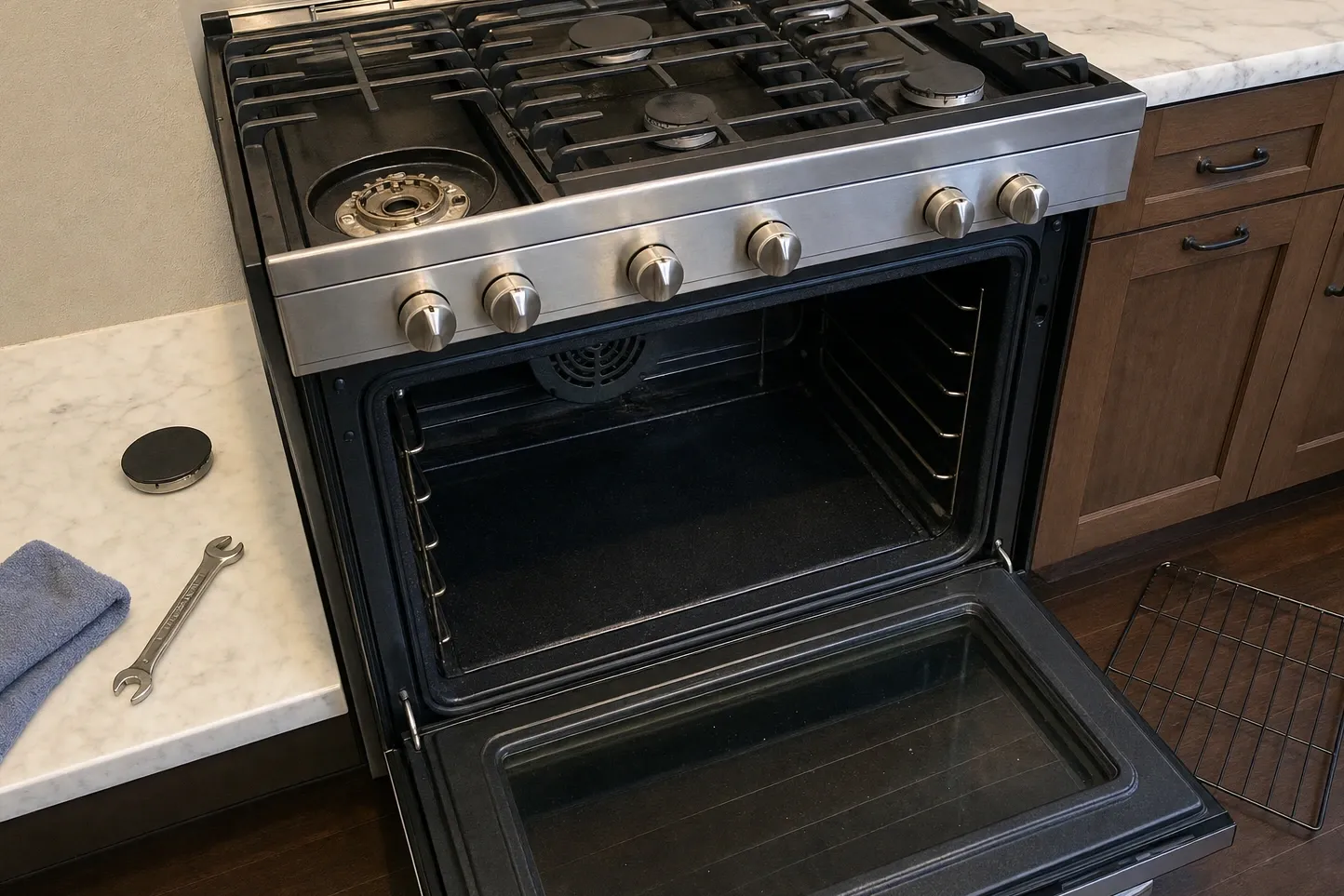
A house sale hands over the kitchen exactly as it stands. Whatever is built into the cabinetry is part of the price whether or not anybody discussed it, and in much of the Denver metro that means a professional range, a hood, a panelled refrigerator and a dishwasher that were chosen by somebody else, for a way of cooking that may not be yours. An hour spent looking, during the viewing and again inside the inspection period, tells you most of what you would otherwise learn slowly and expensively.
Photograph the plate on every machine
Each appliance carries an identification label, and the single most useful thing a buyer can do is find it and photograph it. The label does not live in the same spot on every machine: it might be behind a lower panel, inside a door frame, under a drawer, or on a surface that only shows when something is open. So the instruction is not where to look, it is keep looking until you find it, then hold the camera steady enough that the characters are readable afterwards.
Photograph rather than transcribe. Model numbers are long strings of letters and digits in which a single mistyped character sends you to the wrong manual, the wrong parts diagram and the wrong installation drawing. Do it for the cooking appliance, the hood, the refrigeration, the dishwasher, anything undercounter, and the grill outside if one is staying.
With those photographs you can download the use and care guide and the installation instructions for each unit before you own it. That is worth doing even when nothing is wrong, because the installation instructions tell you what the opening should have been, which is the yardstick for everything in the next section.
Resist the temptation to read an age out of the serial number. Ask the seller instead for a purchase or installation date and for any service records. A kitchen that comes with a folder has usually been looked after by somebody who kept one.
What a viewing is long enough to test
None of this requires touching gas, refrigerant, wiring or a removable panel. It is all done from the front of the machine, and it is all reasonable to ask for.
Light each surface burner in turn and watch what the flame does once it settles. Set the oven going early in the visit and come back to it at the end, rather than standing in front of it: by then it should be hot, and anything that runs in the cavity should be running. Put the hood through its speeds and stand where the cooking smell would go. Open the refrigerator and let the door close on its own to see how it seats. Start the dishwasher on its shortest programme as you arrive, so it has finished by the time you leave.
Write down what you saw rather than what you assumed. A burner that lights on the third try, an oven that is warm but not hot, a hood that is loud on its lowest setting: each of those is a question, not a verdict, and each is much cheaper to raise before a closing date than after one.
What a poor installation looks like from the outside
Most of what goes wrong with built-in appliances in this metro was decided on the day they went in, and a good deal of it is visible without tools.
Look along the fronts. Doors and panels in one run should sit on the same line; a door standing proud, drooping at the handle end, or catching its neighbour has either been hung badly or is carrying more panel than it was meant to. Look at the floor at the base of a freestanding unit: flooring laid up to the sides rather than under them, or a heavy bead of sealant around the bottom, says the machine has never been drawn out since the day it arrived, and it will not come out easily for the first repair either.
Look at the hood. A duct that leaves the cabinet and disappears into a chase tells you nothing on its own; ask the inspector to follow it and confirm it reaches outside. Look at the joinery around anything built in, and ask whether a grille or a vented plinth has been boxed in by a later cabinet. And in the older housing stock around central Denver — a bungalow with a pop-top, a Denver Square whose kitchen was opened up twice — look at what the cooking appliance is standing on, because heavy equipment has often been slid into a room that was framed for something a great deal lighter.
When a pre-purchase look is worth booking
If the appliances are a real part of what you are paying for, an hour with somebody who repairs them earns its keep during the inspection period. A visit does not make the decision for you. It sorts four unknown machines into the ones that are working, the ones that have already been repaired, and the ones that will want something in the next year or two, and it puts that in writing while there is still a negotiation.
Two questions are worth asking in the same hour, because the answers are awkward to get later. What is this address actually supplied with, and what was the cooking appliance set up to burn? They are not the same question, they are not always the same answer, and in the foothills west of the city they are less often the same answer than buyers expect. Confirm both against the plate and the supplier rather than against the listing.
One term, defined
Rating plate
The label a manufacturer fixes to an appliance carrying its model number, its serial number, its electrical rating and, on gas equipment, the fuel the unit was set up for. It is the identification that stays with the machine when every piece of paperwork has gone.
Spec check
Confirm each of these before anything is cut, ordered or delivered.
- The model and serial number of every appliance included in the sale, photographed rather than copied out by hand
- Whether the manuals, installation instructions and any service invoices are coming with the house
- Where the hood terminates, and whether anything above the ceiling was ever ducted at all
- Whether a built-in unit is held in place by joinery that would have to be cut to get it out
- What the house is supplied with, and what the cooking appliance was set up to burn — two separate questions
Questions on site? Viking Appliance Repair Denver, (720) 770-4189.
Follow-ups we get asked
Can you tell how old a Viking appliance is from its serial number?
Not from a chart found on a forum. The dependable route is paperwork: ask the seller for the purchase or installation date and for any service invoices. Where nothing survives, the model number still leads to the right manual and the right parts list, which is what any later repair actually needs.
Is it worth having the kitchen looked at before closing?
It is when the appliances represent a large share of what you are paying for. A diagnostic visit from Viking Appliance Repair Denver is $89, and it turns four unknown machines into a written list of what runs, what has been worked on and what is waiting. Ring (720) 770-4189 while the inspection window is open.
What should nobody attempt during a viewing?
Anything behind a panel. Leave the gas shutoff where it is, do not disconnect a range to look behind it, and do not drag a built-in out of its opening. Everything an hour can teach you is learnt from the front, with the doors open, the burners lit and the oven up to temperature.