Old House, Pro Kitchen
The Basement Second Kitchen and Undercounter Units
The kitchen nobody uses is the one whose leak nobody finds. Viking Appliance Repair Denver — call (720) 770-4189.
Written by Natalia Vukovic
Role Service technician — water systems and leaks · 17 years in the trade
In the trade Finds where the water goes before deciding what is wrong. A seal that shrank at the corner and a fitting that weeps look the same on the floor and cost nothing alike.
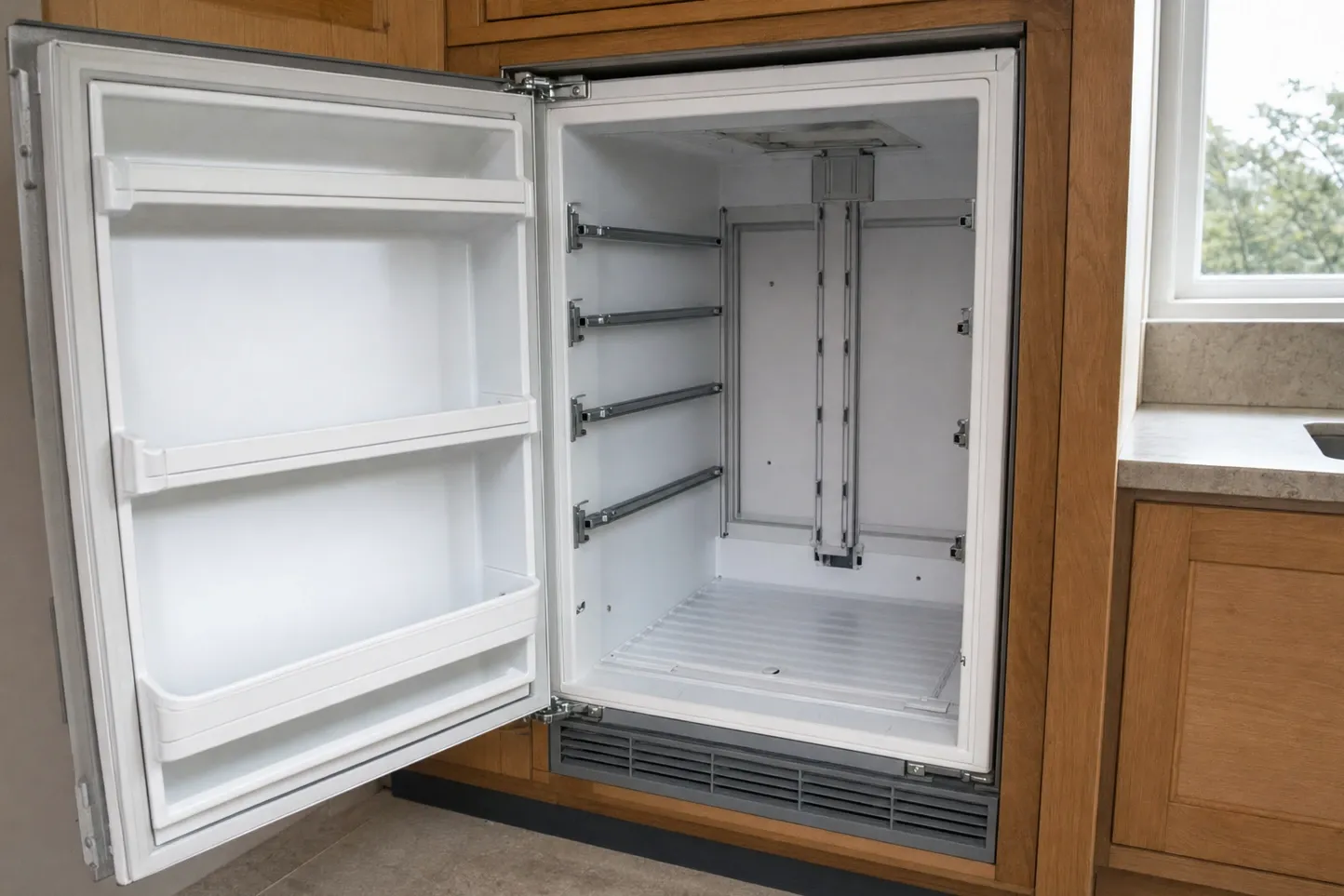
A second kitchen in a finished basement is designed for the few days a year it is busy and then left alone. That is exactly what makes it a different planning problem from the room upstairs. The appliances are the same kind of equipment, often the same brand, but they sit below grade, they run unwatched, and the detail that keeps them working is decided by the joiner and the plumber long before anyone pours a drink at the bar.
Why the second kitchen fails quietly
Upstairs, a refrigerator that stops holding temperature is discovered at breakfast. Downstairs, the same failure can run for a season. A wine unit that has drifted warm looks identical to one that has not. An ice maker that has stopped making ice simply has no ice in it, which is also what it looks like after a quiet month. A small dishwasher that is not draining sits with water in the sump and nobody opens the door.
The consequence is not that the repair is harder. It is that the damage alongside the repair has had time to happen. Water that would have been wiped up in a kitchen has instead soaked into the underside of a cabinet base, into a subfloor, or into the joint between two rooms. By the time somebody notices, the appliance is one line on the list.
Two habits fix most of it, and neither costs anything. Run every appliance down there on a schedule rather than on demand, so a failure is found in a month instead of a year. And keep the model and serial number of each unit written down somewhere other than on the appliance, because the plate on an undercounter unit is often only readable once the unit is out.
Ventilation below grade
Built-in refrigeration and a basement bar are a combination with one recurring mistake in it: the cabinetry closes off the air.
An undercounter appliance is not a freestanding one pushed into a hole. It is designed to be surrounded, which is why the air comes and goes through the grille that fills its own kickplate. Cover that grille and the machine is breathing its own exhaust. It gets covered in ordinary, well-intentioned ways: a continuous toe board run across the whole bar for a cleaner line, flooring lapped up in front of it, a decorative panel added after handover, or simply a case of bottles stored where the air needs to move. What must stay clear, and how far, is written in the installation instructions for the specific model, and it is the page to hand the cabinetmaker rather than a rule of thumb.
Temperature is the other half of it. Manufacturers state the ambient range their refrigeration is designed to work in, and an unheated or partly heated basement corner in a Denver winter is worth measuring against that figure rather than assuming a cool room helps. The number belongs to the model; the measurement belongs to the room.
Cooking ventilation below grade is a separate matter and not one to settle from a web page. If the second kitchen has anything that burns fuel, the exhaust route and the air that replaces it are questions for the mechanical designer and for the authority having jurisdiction at your address, decided before the ceiling goes in.
Drainage and the pump nobody remembers
Above ground, a drain runs downhill and that is the end of the subject. Below the sewer line it does not, and the fixtures in a basement bar frequently discharge into a basin with a pump in it instead.
That adds a component to every appliance down there that uses water, and it is a component with its own float, its own power supply and its own service life. The practical effect is that a dishwasher which will not drain, or a sink backing up under a bar, is as likely to be a pump problem as an appliance problem. Knowing which basin serves which fixture saves a diagnosis.
Ice makers and refrigeration with a water supply bring the same theme from the other direction. The line to them is usually long, often runs through unheated space to get there, and ends at a shutoff that somebody has to be able to reach without emptying a cabinet. Where that valve is, and whether it still turns, is worth establishing while the bar is being built rather than during a leak.
Under all of it, ask what happens to water that escapes. A drip tray or a leak sensor beneath an undercounter unit is a small item at the joinery stage and an obvious one in hindsight, particularly where the floor below the bar is finished timber or sits above another room.
Putting it on the same visit
The efficient way to look after a basement kitchen is to stop treating it as a separate building. When a technician is in the house for the main kitchen, the downstairs units go on the same job: run, checked, grilles cleared, condensers cleaned, water connections looked at.
There is a practical reason beyond convenience. Second-kitchen appliances are often several years older or newer than the ones upstairs, because they went in with a basement finish rather than with the original build. Different generation, different parts, different service history. Having all of it recorded once means the next call starts with the model number rather than with a search behind a toe board, and a job that begins with the right part on the vehicle is a job that ends the same afternoon.
One term, defined
Undercounter unit
An appliance built to sit beneath a worktop at cabinet depth, usually taking its air through a grille in its own kickplate rather than from above or behind, so the joinery drawn around it decides whether it can breathe at all.
Spec check
Confirm each of these before anything is cut, ordered or delivered.
- What each undercounter appliance downstairs actually is, recorded by model and serial from its own plate
- What the model's instructions require to stay clear in front of and around its grille, and whether the joinery respects it
- Whether the room stays inside the ambient range the manufacturer states for that appliance through a Denver winter
- Where every drain down there goes, and whether anything relies on a pump rather than on fall
- Whether a leak under the bar cabinetry would be seen by anyone, and what is under the floor if it is not
Questions on site? Viking Appliance Repair Denver, (720) 770-4189.
Follow-ups we get asked
Why do basement appliances fail without anyone noticing?
Because nothing down there is part of a daily routine. An upstairs refrigerator announces a problem the same morning; a bar unit used a few times a season can run warm, ice over or drip for months before a person opens the door. The discovery is usually a smell or a stain, not a fault light.
Does an undercounter refrigerator need a vent cut into the cabinet?
Normally the opposite. These units are built to draw and discharge through the grille across their own kickplate, so what they need is that path left alone: no toe board over it, no flooring lapped across it, no bottles stacked against it. The dimensions to protect come from the installation instructions for that model.
Is a colder basement easier on refrigeration?
Not necessarily. Every manufacturer states an ambient range its appliances are designed to work within, and a room that drops below it can leave a unit running oddly rather than efficiently. Check the figure for the specific model against how cold that corner really gets in January before assuming the basement is doing the machine a favour.
What is worth doing while the main kitchen is being seen anyway?
Add the downstairs units to the same visit. They are frequently a different generation from the appliances upstairs and they are the ones nobody has looked behind in years. Having them checked, cleaned and run while a technician is already in the house costs far less attention than discovering a failure on your own later.
