A Mile Up
Burner Output at Altitude: What to Tell a Client Before They Choose
What a client should expect from a burner at this elevation, said early. Viking Appliance Repair Denver — call (720) 770-4189.
Written by Natalia Vukovic
Role Service technician — water systems and leaks · 17 years in the trade
In the trade Finds where the water goes before deciding what is wrong. A seal that shrank at the corner and a fitting that weeps look the same on the floor and cost nothing alike.
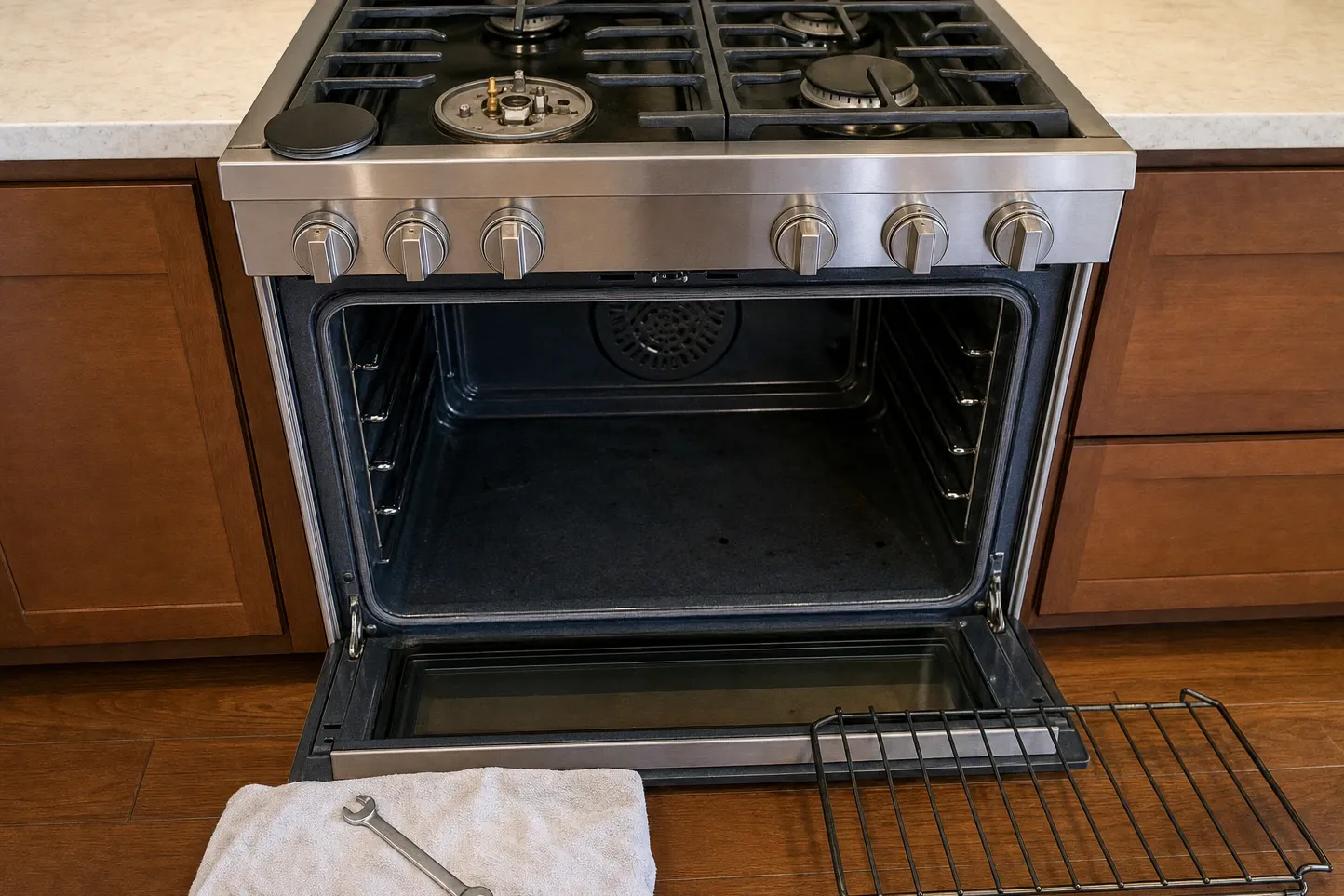
A client picks a professional range out of a brochure, and the number they remember is the burner’s rated input. Nobody in the showroom mentions that the figure was written for ground a good deal lower than this. Saying so before the order is a thirty-second conversation. Saying so after the first dinner party is an argument about whether the appliance is faulty.
What the code convention actually says
Published input ratings are written for elevations up to two thousand feet. Above that line, the model fuel gas code the Colorado jurisdictions work from treats the rating as something to be reduced, and it gives three routes: an arithmetic allowance of four per cent for each thousand feet of elevation, a figure the authority having jurisdiction will accept, or whatever the manufacturer’s own installation instructions specify for that appliance.
Designers reliably remember the arithmetic and forget the third route, which is the one that governs. The code says plainly that where a code provision is less restrictive than the conditions of an appliance’s listing or its installation instructions, the listing and the instructions apply — and it requires those instructions to be on the job when the inspector arrives. Four per cent is the default for the case where the manufacturer has published nothing. It is not a law of physics that overrules a table printed by the people who built the burner.
The same adjustment turns up a second time, in a different trade’s calculation. Gas pipe is sized to meet maximum demand, taken as the sum of the maximum inputs of everything it feeds, and that volume is itself adjusted for altitude above two thousand feet. One elevation, two calculations, two sets of drawings. Neither of them belongs to the person who will be cooking.
What that does to the client’s expectation
Translated into a kitchen, the allowance is modest and the client’s imagination is not. The fair way to describe it is that a large pot takes a little longer to come up, and a hard sear wants a little more patience and a drier pan. It is not the gap between a professional appliance and a builder’s one, and a client who has been warned to expect a catastrophe will duly find one in the first week.
There is a quieter trap in how the pitch usually gets made. Burner input is a rate of fuel, not a temperature and not a result. Two burners carrying the same published figure can behave quite differently depending on how the grate sits, how far the flame spreads under a pan and how well the pan conducts. A client choosing between two ranges on input alone is comparing the least informative number on the specification sheet.
What it does not excuse
The allowance is no reason to specify a larger appliance than the room can vent or the supply can feed. Going up a size to claw back an altitude adjustment shifts the problem into the ventilation drawing and onto the meter, and both of those cost more to solve than the thing it was meant to fix.
It is no reason to have burner parts swapped at this elevation either. Whether anything is changed at installation is settled by the manufacturer’s table for the model in hand, not by the elevation sign at the city limit, and it is entirely reasonable to ask an installer to show that in writing before they open a box.
And it explains nothing about an appliance that behaves badly. A burner that will not hold a low flame, lights lazily, or drops away when the oven fires is not demonstrating altitude. It is doing something with a cause and a repair, and the altitude conversation only muddies it.
How to say it before they choose
Three sentences at the specification meeting usually do it. The rated input on the brochure was written for lower ground, so expect slightly less of it here. Whether the appliance needs anything done to it at this elevation is answered by the instructions for the exact model, which somebody will read before the order goes in. Everything else anyone has told them about the mile belongs to the pot rather than to the range.
Then put it in the file. The specification should name the model number, the fuel the property runs, the elevation recorded for the address, and the input the gas piping design was sized around. Four lines. They cost nothing at the drawing stage, and they settle every altitude argument that would otherwise turn up two years later with no paperwork behind it.
One term, defined
Input derating
The allowance made to a gas appliance's published input rating when it is installed above two thousand feet. It is a sizing convention rather than a defect, and the manufacturer's own instructions for the model override the arithmetic wherever they say something different.
Spec check
Confirm each of these before anything is cut, ordered or delivered.
- The elevation the piping designer worked from, and whether it came off the address or off a guess about the city
- What the installation instructions for the exact model number say about elevation, printed and kept with the job file
- Whether the specification was written around the published input or around an input already reduced for altitude
- Which trade is carrying the altitude adjustment in their own figures — the designer, the gas fitter, or both of them
Questions on site? Viking Appliance Repair Denver, (720) 770-4189.
Follow-ups we get asked
Does a professional range lose much power at Denver's elevation?
Less than most people expect. The fuel gas code applies an allowance above two thousand feet, and at this elevation it is a modest reduction rather than a transformation. A client will notice a pot of water taking slightly longer, not a range that cannot sear. Viking Appliance Repair Denver can talk it through on (720) 770-4189.
Should the specification quote the derated input or the published one?
Both, and label which is which. The published figure identifies the appliance; the adjusted figure is what the gas piping design and the meter conversation need. Writing only one of them is how a kitchen ends up with a pipe sized against the wrong number and nobody able to say who chose it.
Does every gas appliance in the house get the same adjustment?
The convention applies to gas appliances generally, but each one is governed first by its own instructions, so the furnace, the water heater and the range can each be treated differently. That matters when the whole connected load is added up, because the numbers going into that sum have to be consistent.